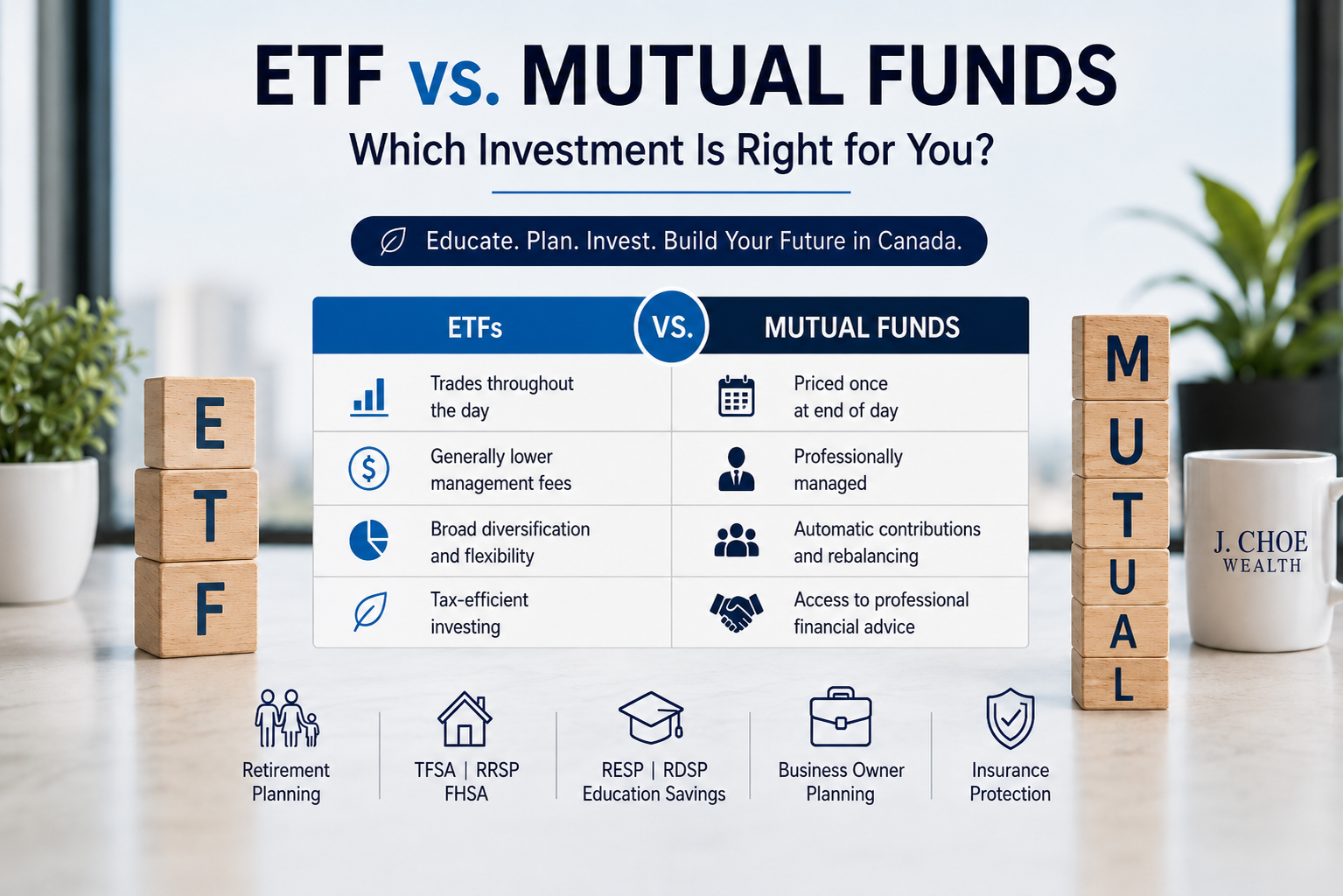
ETF vs. Mutual Funds in Canada
When Canadians begin investing, one of the first questions they often ask is:
“Should I invest in ETFs or mutual funds?”
The answer isn’t as simple as saying one is better than the other. Both investment options can play an important role in building long-term wealth. The right choice depends on your goals, experience, investment style, and the level of professional guidance you prefer.
Let’s explore the differences.
What is an ETF?
An Exchange-Traded Fund (ETF) is a basket of investments that trades on a stock exchange, much like an individual stock.
Many ETFs track an index such as the S&P/TSX Composite Index or the S&P 500, while others are actively managed by professional portfolio managers.
ETFs typically offer:
- Broad diversification
- Lower management fees
- Intraday trading flexibility
- Tax-efficient portfolio management
- Easy access to Canadian and global markets
What is a Mutual Fund?
A mutual fund pools money from many investors and is professionally managed according to a specific investment mandate.
Unlike ETFs, mutual funds are purchased directly through financial institutions or licensed advisors and are priced once at the end of each trading day.
Mutual funds often provide:
- Professional portfolio management
- Automatic rebalancing
- Dollar-cost averaging options
- Pre-authorized contribution plans
- Personalized advice through licensed financial professionals
| Feature | ETFs | Mutual Funds |
|---|---|---|
| Trading | Throughout the day | End-of-day pricing |
| Management | Passive or Active | Primarily Active |
| Minimum Investment | Often low | Varies by fund |
| Fees | Generally lower | Varies depending on strategy |
| Professional Advice | Optional | Commonly available |
| Automatic Contributions | Limited depending on platform | Widely available |
Which Option Is Better?
The better question is not “Which investment is better?”
Instead, ask:
“Which investment is better for my situation?”
Someone who enjoys managing their own investments may appreciate ETFs for their flexibility and lower costs.
Someone who values professional guidance, behavioural coaching, and ongoing portfolio reviews may benefit from professionally managed mutual funds.
Many successful Canadian investors actually use both.
Where Can ETFs Fit Into Your Financial Plan?
ETFs can be suitable investments for many registered and non-registered accounts, including:
- TFSA
- RRSP
- FHSA
- RESP
- Corporate investment accounts
- Non-registered investment accounts
The key is ensuring your investments match your time horizon, risk tolerance, and financial objectives.
Investing Is About More Than Choosing Products
Successful investing is rarely determined by selecting the “perfect” investment.
Long-term success often comes from:
- Staying invested during market volatility
- Maintaining diversification
- Managing investment costs
- Rebalancing periodically
- Following a disciplined financial plan
- Avoiding emotional investment decisions
Financial planning is not about predicting tomorrow’s market—it is about preparing for your future.
Final Thoughts
Both ETFs and mutual funds offer valuable benefits to Canadian investors.
Rather than focusing solely on fees or market performance, consider how an investment fits within your overall financial plan.
Whether you’re saving for retirement, building wealth, purchasing your first home, or planning for your children’s education, choosing an investment strategy that aligns with your goals is often more important than choosing between two investment products.
Education is the first step toward making confident financial decisions.
FAQ
Are ETFs better than mutual funds?
Not necessarily. Both have advantages. The right choice depends on your investment objectives, risk tolerance, costs, and whether you prefer managing investments yourself or working with a financial advisor.
Can I own both ETFs and mutual funds?
Yes. Many investors combine both to achieve diversification while benefiting from professional management and cost-efficient market exposure.
Are ETFs suitable for retirement investing?
They can be. ETFs are commonly used within RRSPs, TFSAs, FHSAs, and other investment accounts as part of a diversified long-term investment strategy.
Do mutual funds still make sense?
Yes. Professionally managed mutual funds may provide ongoing portfolio management, disciplined investing, and behavioural guidance that many investors find valuable.
This article is provided for general educational purposes only and should not be considered investment, tax, legal, or financial advice. Investment products involve risk, and past performance does not guarantee future results. Before making investment decisions, consult with a qualified financial professional to determine what is appropriate for your individual circumstances. Investment products and services are offered through Investia Financial Services Inc. Insurance products and services are offered through multiple insurance carriers via PPI Management Inc. Availability may vary by province and individual eligibility.
Legal Notice & Financial Disclaimer
Need Help Choosing Between ETFs and Mutual Funds?
Choosing between ETFs and mutual funds does not have to be confusing.
Both options can play an important role in a well-structured investment plan. The key is understanding how each one fits your goals, risk tolerance, time horizon, and preferred level of guidance.
Whether you are investing through a TFSA, RRSP, FHSA, RESP, or a non-registered account, the right strategy should be built around your personal financial situation — not just the latest market trend.
If you would like to review your investment options, compare ETFs and mutual funds, or build a plan that fits your long-term goals, feel free to reach out.
A clear plan starts with a simple conversation.