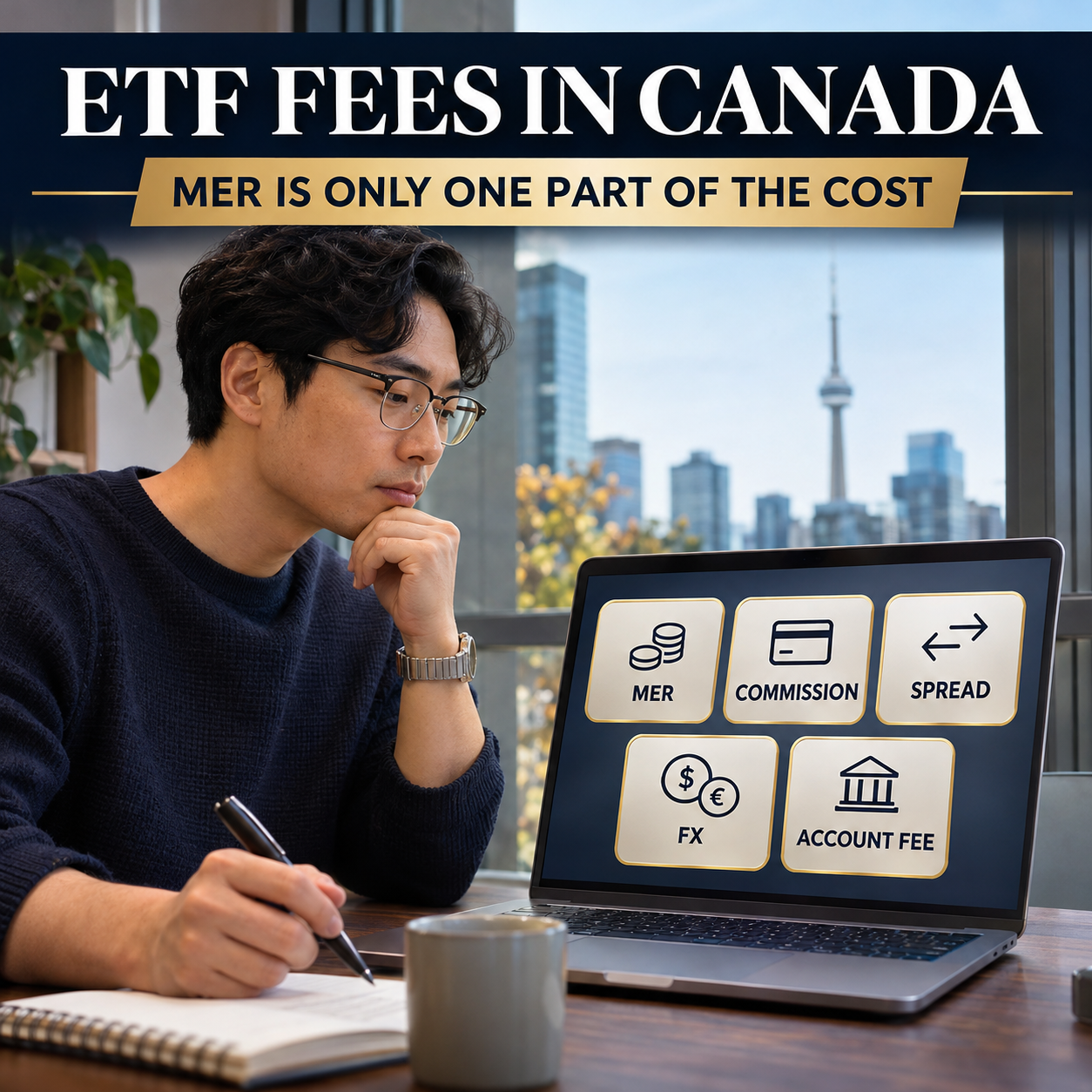


ETF Fees in Canada involve more than the management expense ratio. An ETF may have a low MER and still create other costs through trading, currency conversion or account charges. The real question is not simply, “What is the MER?” It is, “What will this ETF cost me to buy, own and eventually sell?”

The short answer
An ETF can create costs at three different stages.
- You may pay a commission, spread or currency conversion cost when buying it.
- The fund deducts its ongoing expenses while you own it.
- You may face another commission, spread, currency conversion cost or tax when selling it.
Some charges appear clearly on your statement. Others are built into the ETF’s value or the price you receive. Therefore, “commission-free” does not mean “cost-free.”
ETF Fees in Canada at a glance
| Cost | When it applies | Where you may find it |
|---|---|---|
| Management fee | While you own the ETF | ETF Facts and fund documents |
| MER | While you own the ETF | ETF Facts |
| Trading expense ratio | When the ETF trades its holdings | Fund reports and disclosures |
| Brokerage commission | When you buy or sell | Brokerage fee schedule |
| Bid-ask spread | When you buy or sell | Trading screen and ETF Facts |
| Premium or discount to NAV | When the market price differs from asset value | ETF Facts and fund website |
| Currency conversion | When Canadian dollars are exchanged | Brokerage fee schedule |
| Account or administration fee | Depending on the account | Brokerage or adviser agreement |
| Advice or portfolio fee | When advice or portfolio management is provided separately | Client agreement and statements |
| Tax drag | Depending on the investment and account | Tax slips and professional advice |
The Canadian Securities Administrators explains that ETF Facts includes information about MER, trading data and the costs of buying, owning and selling an ETF. Your brokerage agreement completes the picture because platform charges do not appear in ETF Facts.
What does the MER actually mean?
MER stands for management expense ratio. It shows the fund’s annual operating expenses as a percentage of its average assets.
The MER normally includes the management fee. It also includes eligible operating expenses and applicable taxes. However, it does not include every cost an investor may face.
You do not usually receive a separate MER invoice. Instead, the fund pays these expenses from its assets. As a result, the cost is already reflected in the ETF’s reported return and net asset value.
Suppose you hold $25,000 in an ETF with a 0.20% MER. The approximate annual cost would be:
$25,000 × 0.20% = $50
If the balance changes during the year, the actual amount will also change. The calculation is still useful because it turns a percentage into dollars.
Now consider $100,000 in an ETF with a 0.75% MER:
$100,000 × 0.75% = $750
The difference matters more as the account grows. Still, cost should not be judged alone. Strategy, risk, diversification and investor behaviour also matter.
Management fee, MER and trading expenses are not identical
These three terms are easy to mix up.
- The management fee pays the fund manager for managing the ETF.
- The MER includes the management fee and eligible operating expenses.
- The trading expense ratio, often called TER, reports certain costs created when the ETF trades investments inside the portfolio.
Portfolio trading costs are not generally included in the MER. A strategy with frequent trading can therefore cost more than its MER suggests. Check the fund’s latest reports and disclosure documents for the full picture.
The Canadian Investment Regulatory Organization also separates fund expenses from commissions, spreads, advice fees, currency conversion and account charges.
Why ETF Fees in Canada depend on trade size
Many Canadian platforms now offer commission-free trading on selected ETFs. Others charge a flat amount for each trade. Always check whether the offer applies to both purchases and sales.
Imagine paying a $9.99 commission to invest $200. The commission alone equals almost 5% of the purchase. That is a large hurdle before the investment begins to grow.
On a $10,000 purchase, the same $9.99 represents about 0.10%. Therefore, trade size and frequency change the importance of commissions.
Commission-free trading can help with small recurring purchases. However, the MER, spread, currency costs and account fees may still apply.
The bid-ask spread is a real trading cost
An ETF trades on an exchange. Buyers offer a bid price, while sellers ask for a higher price. The gap is called the bid-ask spread.
For example, an ETF might show:
- Bid: $24.98
- Ask: $25.02
- Spread: $0.04 per unit
Buying 200 units at the ask and immediately selling at the bid would create an $8 difference. That calculation assumes no market movement and no commission.
Highly traded ETFs often have tighter spreads. Less liquid or specialized ETFs may have wider spreads. Still, trading volume alone does not tell the whole story. The liquidity of the ETF’s underlying investments also matters.
A limit order can help you control the maximum purchase price or minimum sale price. It does not guarantee that the trade will be completed.
Market price can differ from net asset value
An ETF has a net asset value, usually shortened to NAV. It also has a market price on the exchange.
When the market price is above NAV, the ETF trades at a premium. When it is below NAV, the ETF trades at a discount.
Small differences are normal. Larger gaps can appear during volatile markets or when the underlying market is closed. For that reason, avoid assuming that the last quoted price always reflects the portfolio’s current value.
Currency conversion can overwhelm a low MER
A U.S.-listed ETF may advertise a very low expense ratio. Yet a Canadian investor may need to convert Canadian dollars into U.S. dollars.
Suppose a platform charges 1.5% for a currency conversion. Converting $10,000 would cost about $150 in this simplified example. Another conversion may apply when the money returns to Canadian dollars.
Actual currency charges vary widely. Some platforms build the cost into the exchange rate. Others show it separately. Therefore, compare the quoted rate with the current market rate and read the brokerage fee schedule. This is one reason ETF Fees in Canada can differ between platforms.
Foreign-listed ETFs can also involve different tax and withholding rules. The account type, asset location and country of the underlying investment can all matter. The Ontario Securities Commission’s investor education site provides a useful overview of foreign-listed ETF costs and tax considerations.
Account fees sit outside the ETF
The ETF provider does not control every charge. Your financial institution may apply separate account costs.
Possible examples include:
- Annual administration fees
- Registered account fees
- Transfer-out fees
- Inactivity or minimum-balance fees
- Statement or service charges
- Advice or managed-account fees
These costs can matter greatly in a smaller account. A $100 annual fee equals 1% of a $10,000 balance. The same charge equals 0.10% of a $100,000 balance.
Advice fees and fund fees pay for different services
An ETF’s MER pays for managing the investment fund. It does not automatically pay for a personal financial plan or ongoing advice.
Some investors use a fee-based adviser. Others use a robo-adviser or managed portfolio. In those cases, a separate advice or portfolio-management fee may apply on top of the underlying ETF expenses.
Ask what service each fee covers. Also ask whether tax planning, rebalancing, financial planning and regular reviews are included.
Taxes are not ETF fees, but they still affect your return
Tax is not part of the ETF’s price tag. Nevertheless, it can change what you keep.
In a non-registered account, distributions and capital gains may create taxable income. Foreign withholding tax can also apply. In addition, selling an ETF may create a capital gain or loss.
Registered accounts change the tax treatment. However, they do not remove every possible withholding tax. The result depends on the account, the ETF structure and the source of income.
That is why the lowest-fee ETF is not always the lowest-cost choice after tax.
Does a higher-cost ETF ever make sense?
Yes, but the higher cost should buy something useful.
An actively managed ETF may charge more for research and security selection. A specialized ETF may provide access that is difficult to build alone. A one-ticket portfolio may also handle rebalancing for you.
The important question is whether the added feature supports your plan. A higher fee is not proof of better performance. Likewise, a lower fee does not repair a poor strategy.
How to find ETF Fees in Canada before you buy
Start with the ETF Facts document. Then check the brokerage’s fee schedule.
Use this order:
- Find the MER and management fee in ETF Facts.
- Review the historical bid-ask spread and trading information.
- Check whether the market price often differs from NAV.
- Look for portfolio trading costs in the fund’s reports.
- Confirm the brokerage commission for buying and selling.
- Check currency conversion charges.
- Review account, transfer and advice fees.
- Consider tax treatment in the account you will use.
This process takes a few minutes. However, it can reveal costs that a headline MER does not show.
A practical ETF cost example
Assume an investor plans to buy $5,000 of a Canadian-listed ETF.
| Item | Hypothetical amount | What it means |
|---|---|---|
| MER | 0.25% | About $12.50 a year on a steady $5,000 balance |
| Purchase commission | $9.99 | One-time trading charge |
| Bid-ask impact | $4.00 | Hypothetical spread cost on the order |
| Account fee | $0 | No annual charge in this example |
| Currency conversion | $0 | The ETF trades in Canadian dollars |
The first-year cost would be about $26.49 in this simplified example. Market movements and taxes are not included.
Now change one detail. Suppose the ETF trades in U.S. dollars and the platform charges 1.5% to convert the $5,000. The conversion alone would add about $75.
The lesson is simple. ETF Fees in Canada should be measured in dollars, not only percentages.
Questions to ask before placing the order
- What is the MER in dollars on my expected balance?
- Does the fund report material portfolio trading costs?
- What commission will I pay to buy and sell?
- How wide is the bid-ask spread?
- Am I buying near a reasonable price compared with NAV?
- Will I need to convert currency?
- Does my account charge annual or transfer fees?
- Am I also paying for advice or portfolio management?
- How will distributions and gains be taxed?
- Could a simpler Canadian-listed alternative reduce friction?
Johnny’s take
I would never choose an ETF from the MER alone. The MER is important, but it is only one line in the total cost.
For a long-term investor, ongoing expenses deserve attention; For someone making small trades, commissions and spreads may matter more; For a Canadian buying U.S.-listed ETFs, currency conversion can become the largest immediate cost.
Start with the investment goal. Then compare the full cost of reaching it. When reviewing ETF Fees in Canada, convert each percentage and charge into dollars. The best ETF is not necessarily the cheapest one. It is the one that fits the plan at a reasonable total cost.
Related reading
- Are Mutual Funds Safer Than ETFs in Canada?
- Active ETFs vs Mutual Funds in Canada
- ETF vs. Mutual Funds: Which Investment Is Right for You in Canada?
Visit Johnny’s Bookstore
Would you like to learn more about Canadian investing, registered accounts and personal finance?
Need help?
If you would like help understanding investment costs or comparing the choices available in your account, feel free to contact me.
Important notice
This article is for general educational purposes only. It does not provide personalized investment, tax or legal advice. Product costs, brokerage fees and tax rules can change. Review the latest disclosure documents and speak with a qualified professional when needed.
