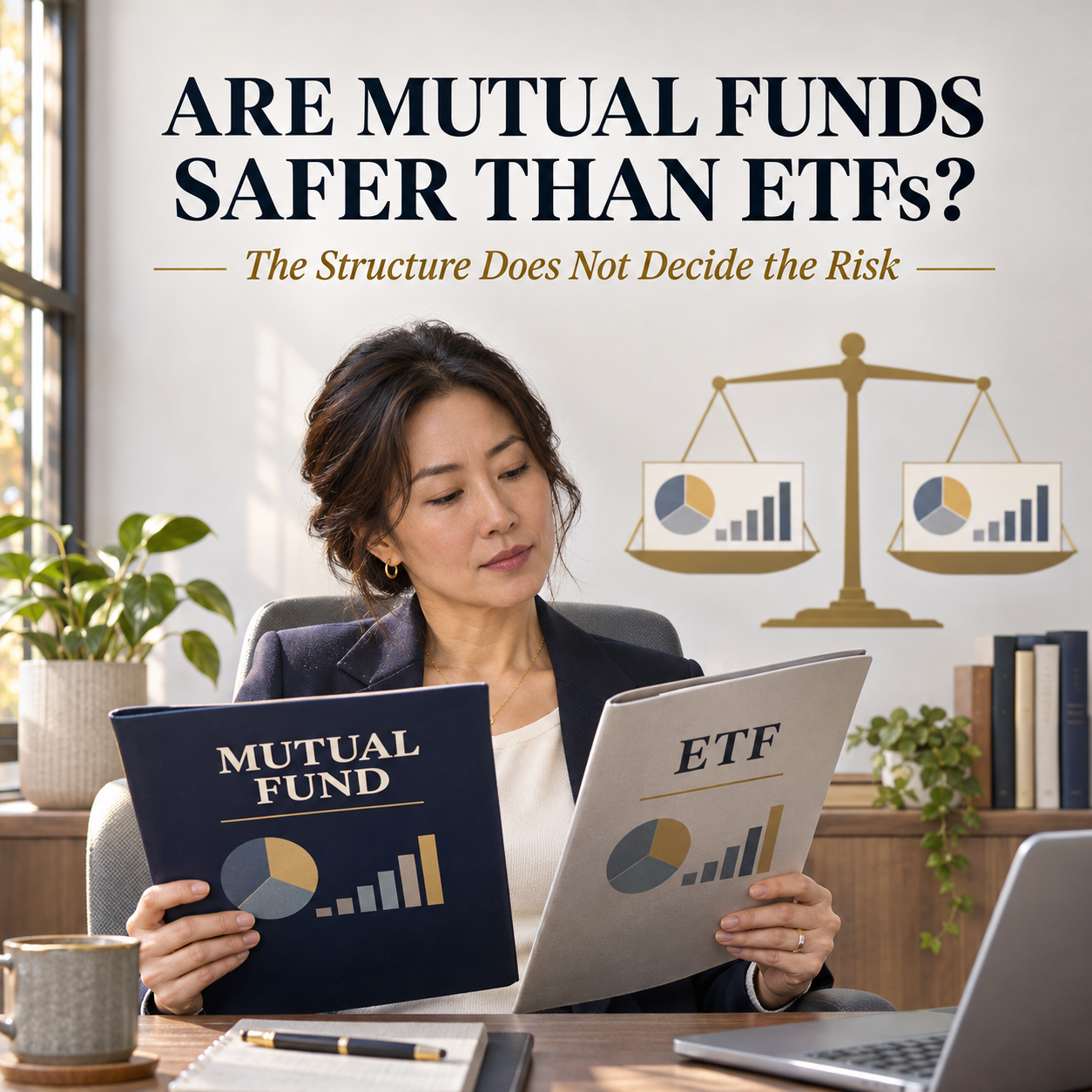


Are mutual funds safer than ETFs in Canada? The short answer is no. Neither structure is automatically safer. The risk depends mainly on what the fund owns, how diversified it is and how you use it.

A conservative bond mutual fund may be less volatile than a technology ETF. However, a broadly diversified balanced ETF may carry less risk than a mutual fund concentrated in one sector.
That is why comparing the labels alone can be misleading. Instead, compare the investments inside each fund and the role it will play in your portfolio.
Mutual funds and ETFs are both investment funds
A mutual fund and an exchange-traded fund (ETF) can both hold a collection of investments. Those holdings may include stocks, bonds, cash, commodities or a combination of assets.
The main structural difference is how investors buy and sell them.
| Feature | Mutual fund | ETF |
|---|---|---|
| Trading method | Purchased or redeemed through a fund company or dealer | Bought and sold on a stock exchange |
| Pricing | Usually once daily at net asset value | Market price changes throughout the trading day |
| Management style | Active or passive | Active or passive |
| Diversification | Depends on the holdings | Depends on the holdings |
| Risk level | Depends on the holdings and strategy | Depends on the holdings and strategy |
| Main disclosure | Fund Facts | ETF Facts |
The Canadian Investment Regulatory Organization explains that the risk of either structure depends on what the fund invests in. You can review its overview of mutual funds and ETFs.
What actually makes a fund risky?
When asking whether mutual funds are safer than ETFs, start with the fund’s holdings. Several factors can change the risk significantly.
Asset class: A stock fund will usually fluctuate more than a money market fund. Long-term bond funds may also move sharply when interest rates change.
Concentration: A fund holding one industry or country may fall much more than a broadly diversified fund.
Investment strategy: Leverage, derivatives, short selling and covered-call strategies can change both the return and the risk.
Credit quality: A bond fund holding lower-quality corporate debt may carry more default risk than one holding government bonds.
Currency exposure: Foreign investments may rise or fall as exchange rates change. Currency hedging can also affect the result.
Liquidity: Some securities are harder to trade during stressed markets. That can affect pricing and the fund’s ability to transact efficiently.
Time horizon: A suitable investment for a 25-year retirement goal may be inappropriate for next year’s home down payment.
Therefore, the product label tells you very little about safety by itself.
Three comparisons that show why the label can mislead you
Consider these simplified examples.
| Comparison | Likely lower-risk choice | Why |
|---|---|---|
| Money market mutual fund vs. leveraged equity ETF | Money market mutual fund | The ETF uses leverage and owns volatile assets |
| Diversified balanced ETF vs. technology-sector mutual fund | Balanced ETF | It spreads money across more assets and sectors |
| Broad Canadian equity mutual fund vs. broad Canadian equity ETF | Neither automatically | Their holdings and market exposure may be very similar |
In the third example, fees, portfolio construction and investor behaviour may create different results. Still, their underlying market risk could be close.
This is why a fair comparison begins with two funds that have similar objectives.
Does professional management make a mutual fund safer?
Not automatically. Professional management means a portfolio team makes decisions inside the fund. It does not remove market risk or guarantee protection from losses.
An active manager may reduce exposure to an investment that appears overvalued. On the other hand, the manager may make a poor decision or underperform the market.
Passive ETFs also follow rules. A broad index ETF may hold hundreds or thousands of securities. That diversification can reduce company-specific risk, even without active security selection.
Also, active ETFs and index mutual funds both exist. Therefore, active management and the fund structure are separate questions.
Does diversification make one structure safer?
Both structures can provide excellent diversification. Both can also be highly concentrated.
A global equity ETF may own thousands of companies. Meanwhile, a thematic ETF may hold a small group of businesses from one industry.
The same range exists among mutual funds. Some funds spread money across several regions and asset classes. Others focus narrowly on technology, energy or emerging markets.
CIRO notes that diversification can reduce risk by combining investments that do not always move together. However, simply owning several funds does not guarantee diversification. They may hold many of the same securities. Its portfolio diversification guide explains this relationship.
Check the top holdings, sector weights, geographic mix and asset allocation. Those details tell you far more than the words ETF or mutual fund.
Why an ETF can feel riskier during the trading day
ETF prices move throughout the day because ETFs trade on an exchange. Investors can see every price change and react immediately.
That flexibility can help when you need to place a trade. However, it can also encourage emotional decisions during a volatile market.
ETF investors should also understand two prices:
- Market price: The price buyers and sellers agree on during trading hours
- Net asset value (NAV): The calculated value of the fund’s underlying holdings
An ETF can trade slightly above or below its NAV. The difference may become more noticeable when markets are volatile or the underlying holdings are difficult to price.
The bid-ask spread also matters. This is the gap between the highest buying price and the lowest selling price. A wider spread increases the cost of entering or leaving the position.
These trading features do not necessarily make an ETF a bad investment. Still, investors should understand them and use appropriate order types.
The Canadian Securities Administrators’ ETF Facts guide explains market price, NAV, bid-ask spreads, risk ratings and costs.
Does once-a-day pricing make a mutual fund safer?
No. A conventional mutual fund usually processes purchases and redemptions at a net asset value calculated once daily.
As a result, investors do not see the price moving every few seconds. That can make the experience feel calmer. It may also discourage impulsive trading.
However, the holdings can still lose value throughout the day. The absence of an intraday price does not remove investment risk.
Once-a-day pricing changes how you transact. It does not guarantee that your money is safer.
Can low fees make an ETF safer?
Lower costs can help an investor keep more of the fund’s return. Yet cost and risk are different concepts.
A low-cost leveraged ETF may still be very risky. Meanwhile, a higher-cost conservative mutual fund may fluctuate much less.
The management expense ratio (MER) matters because it reduces returns over time. ETF investors may also face trading commissions, bid-ask spreads and currency-conversion costs. Mutual fund costs can vary by fund and series.
Compare total costs after you compare the funds’ objectives and holdings. Choosing only by MER can lead you to the wrong investment.
Are mutual funds and ETFs guaranteed?
Generally, neither one protects you from market losses. An investment fund is not the same as a savings account or guaranteed investment certificate.
Even a fund with a low risk rating can lose money. The amount may be smaller or less frequent than with a high-risk fund, but low risk does not mean no risk.
Before investing, confirm whether the product includes any guarantee. Do not assume protection simply because a bank or familiar financial institution offers it.
How should you use the risk rating?
Fund Facts and ETF Facts show a risk rating that generally ranges from low to high. The rating gives investors a useful starting point for comparing funds.
However, it has limits. The rating relies heavily on historical volatility. It cannot predict every future loss or capture every type of risk.
For example, it may not fully show:
- the effect of a sudden market disruption
- concentration in a small group of holdings
- liquidity problems during stressed markets
- how currencies may move
- whether the investment fits your withdrawal date
- how you may react after a sharp decline
Risk ratings can also change. Always review the current disclosure document rather than relying on an older copy.
Read Fund Facts and ETF Facts before buying
You do not need to guess whether a particular fund is risky. Start with its disclosure document.
For either structure, review:
- Investment objective
- Top holdings
- Asset, sector and geographic mix
- Risk rating
- Worst three-month return shown
- Annual performance history
- MER and other expenses
- Trading or redemption costs
- Investor profile described in the document
The worst three-month return can make the risk feel more concrete. Ask whether you could remain invested after a similar decline.
Past performance does not predict the next result. Still, the disclosure documents help you understand how the fund has behaved and what it owns.
Your behaviour can create additional risk
Two investors can own the same ETF and experience different outcomes.
One investor contributes regularly and holds through market declines. Another checks prices constantly, sells after a drop and returns only after the market recovers.
The investment is identical. The behaviour is not.
Mutual funds can also be misused. Investors may chase last year’s winning fund, hold too many overlapping products or switch strategies repeatedly.
Trading convenience, professional management and automatic contributions can influence behaviour. However, no structure can replace a clear plan.
When might a mutual fund feel safer to an investor?
A mutual fund arrangement may feel more manageable when an investor values:
- automatic contributions
- help selecting and maintaining a portfolio
- less temptation to trade during the day
- a professionally managed strategy
- a service relationship connected to the account
However, the investor must confirm which services are actually included. Owning a mutual fund does not automatically provide comprehensive financial advice.
When might an ETF feel safer to an investor?
An ETF approach may feel more manageable when an investor values:
- broad diversification through one fund
- transparent holdings
- lower ongoing fund costs
- control over purchases and sales
- the ability to build and rebalance a portfolio independently
Still, greater control creates more responsibility. The investor must understand trading, portfolio allocation and personal behaviour.
Are mutual funds safer than ETFs in a market crash?
Not necessarily. Two funds holding similar investments may fall by similar amounts during a market decline.
An ETF shows its changing market price throughout the day. A mutual fund normally reports its new net asset value after the market closes. Therefore, the ETF’s loss may be more visible, but the mutual fund’s holdings are still moving.
Diversification, asset mix and liquidity matter more during a crisis than the product label. A balanced fund may decline less than an all-equity fund. However, no ordinary investment fund can promise protection from a market loss.
Are mutual funds safer than ETFs for beginners?
The answer depends on the support and investment involved. A beginner may value automatic contributions and help maintaining a mutual fund portfolio. Another beginner may prefer one broadly diversified asset-allocation ETF.
Neither choice removes the need to understand the investment. Beginners should start with a clear goal, suitable risk and a simple portfolio they can maintain.
Mutual funds safer than ETFs: a practical checklist
Before deciding whether mutual funds are safer than ETFs for your situation, ask these questions:
- Do the two funds have similar objectives?
- What stocks, bonds or other assets do they hold?
- Is either fund concentrated in one sector or country?
- Does the strategy use leverage or complex derivatives?
- How much did the fund lose in its worst recent period?
- How long can I leave the money invested?
- Will I need to sell during a market decline?
- What is the current risk rating?
- What are the total costs?
- Can I follow the strategy without reacting emotionally?
The answers matter more than the wrapper.
Johnny’s take
The question “Are mutual funds safer than ETFs?” sounds simple. Unfortunately, a simple yes or no can lead investors in the wrong direction.
An ETF is not automatically aggressive. A mutual fund is not automatically conservative. Both are containers, and the investments inside those containers create most of the risk.
Start by comparing similar funds. Then review their holdings, diversification, strategy and costs. Finally, consider how you will behave when the market falls.
The safer choice is not always the product with the calmer name. It is the investment you understand, that fits your timeline and that you can hold according to a realistic plan.
Related reading
Visit Johnny’s Bookstore
Would you like to learn more about Canadian investing, registered accounts and personal finance?
Need help?
Do you own several ETFs or mutual funds but feel unsure about the overall risk? I can help you review the holdings, identify overlap and understand how the portfolio fits your goals and time horizon.
Important notice
This article provides general investment education based on information available on November 16, 2026. Fund holdings, fees, risk ratings and disclosure requirements may change. Review the current Fund Facts or ETF Facts before making a decision.
This article does not recommend any particular ETF, mutual fund, advisor, platform or investment strategy. Investment decisions should reflect your goals, time horizon, financial circumstances, risk tolerance and tax situation.
Legal Notice & Financial Disclaimer
