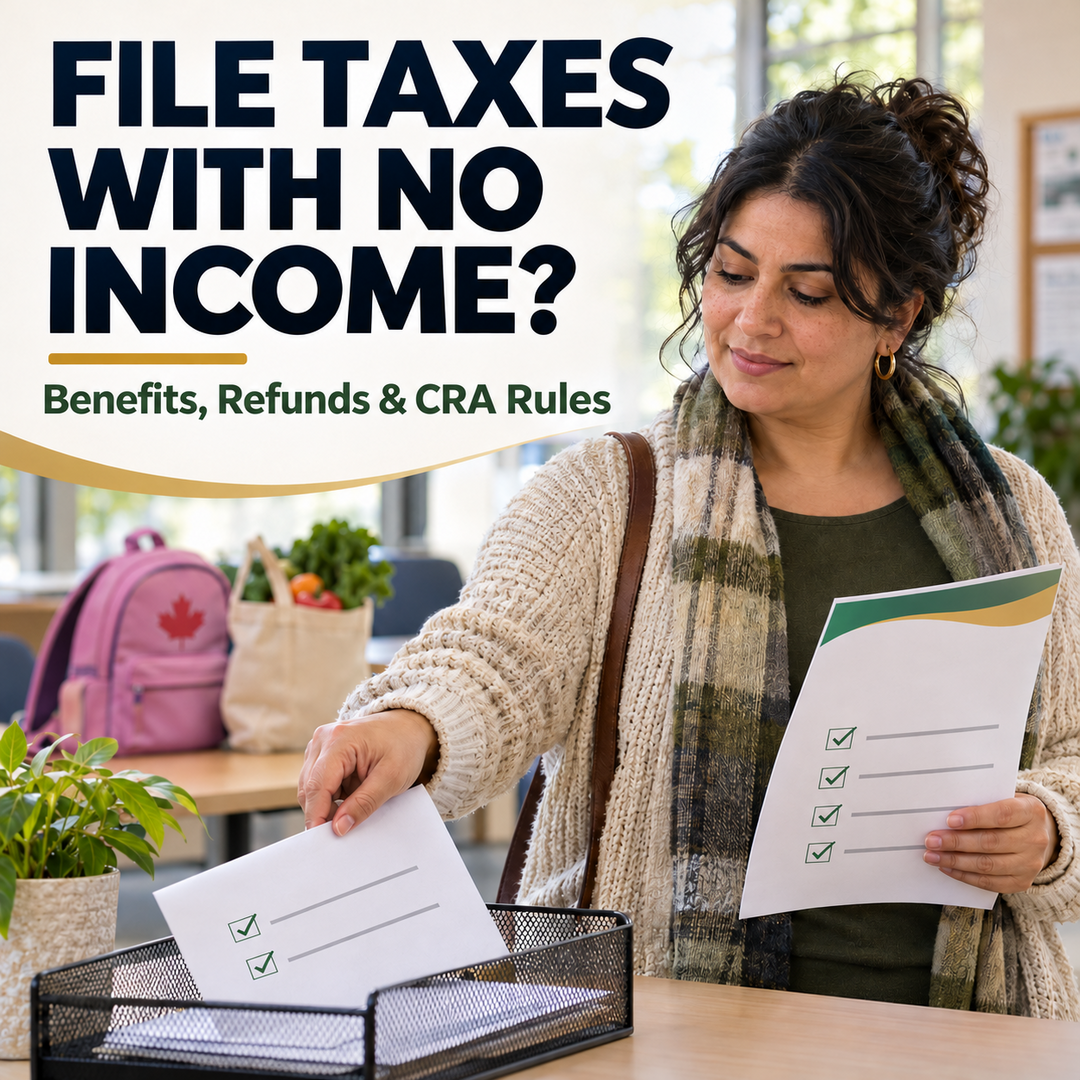


“I did not work last year. Do I still need to file a tax return?”

Many people wonder whether they should file taxes with no income in Canada. If there is no employment income and no tax to pay, filing can seem unnecessary.
However, a Canadian income tax and benefit return does more than calculate tax. The Canada Revenue Agency (CRA) also uses it to confirm family income and calculate government benefits and credits.
That means a return can still matter when the income section shows zero. It may affect your Canada Child Benefit, Canada Groceries and Essentials Benefit, Ontario Trillium Benefit, tuition amounts and other payments.
This guide explains when filing is required, when it is still worthwhile and why a $0 refund does not mean the return had no value.
The short answer: filing is usually a good idea
Not every person with no income is legally required to file a return in every situation.
Still, you may need to file—or have a strong practical reason to file—if any of the following applies:
- the CRA asked you to file a return
- you owe tax or want to claim a refund
- you or your spouse or common-law partner want to begin or continue receiving income-tested benefits
- you sold capital property or realized a taxable capital gain
- you have an outstanding Home Buyers’ Plan or Lifelong Learning Plan repayment
- you want to record or carry forward unused tuition amounts
- you want to report earned income that may create future RRSP deduction room
- you incurred a non-capital loss that you want to use in another year
The CRA’s official Who has to file a return page lists these and other filing situations.
The important point is simple: having no employment income does not automatically remove every reason to file.
“I did not work” does not always mean “I had no income”
A person may have no T4 slip and still have income to report.
Before treating the year as a zero-income year, check for:
- bank interest or GIC interest
- dividends and mutual-fund distributions
- capital gains from selling investments
- RRSP or RRIF withdrawals
- Employment Insurance benefits
- CPP, OAS or other pension income
- rental income
- self-employment or casual business income
- taxable scholarships, grants or other amounts
- foreign income received while resident in Canada for tax purposes
Some of these amounts appear on slips such as a T5, T3, T5008, T4E or pension slip. Others may have to be reported even if no slip was issued.
For example, a bank may not issue a T5 when the interest is below its slip-reporting threshold. That does not necessarily make the interest non-taxable.
The opposite is also true. Benefits such as the Canada Child Benefit and the Canada Groceries and Essentials Benefit are generally not taxable income. Receiving a government payment does not automatically mean it belongs on an income line.
Start by separating “no job income” from “no reportable income of any kind.”
Why file taxes with no income for government benefits?
The CRA uses annual tax returns to determine adjusted family net income. That figure helps calculate many federal and provincial payments.
Without current returns, the CRA may not have enough information to confirm eligibility. Payments can be delayed or temporarily stopped.
| Program | Why the return matters | Typical payment schedule |
|---|---|---|
| Canada Child Benefit (CCB) | Uses adjusted family net income and family information | Monthly |
| Canada Groceries and Essentials Benefit (CGEB) | Uses prior-year family income to determine eligibility and amount | Quarterly |
| Ontario Trillium Benefit (OTB) | Uses the return and, where applicable, Form ON-BEN | Monthly or one annual payment, depending on the election and amount |
| Guaranteed Income Supplement (GIS) | Uses income information to renew or calculate payments | Monthly with OAS |
The Canada Groceries and Essentials Benefit is the current name for the former GST/HST credit.
According to the CRA’s CGEB filing instructions, you should file every year even when there is no income to report. The CRA normally checks eligibility automatically after assessing the return.
This is one of the strongest reasons to file taxes with no income. A return showing zero can still unlock or maintain payments.
Does only one spouse need to file?
No—not when a benefit calculation requires information from both partners.
Canada does not use one joint income tax return for a married or common-law couple. Each person files an individual T1 return.
However, many benefits are based on adjusted family net income. The CRA therefore needs returns from both partners, even if one partner had no income.
Consider a household where one spouse works and the other stays home with the children. The stay-at-home spouse may have no tax to pay and no refund to claim. Their return still helps complete the family-income calculation.
The CRA’s CCB payment guidance states that both spouses or common-law partners must file every year. This applies even when one has tax-exempt income or no income.
If one return is missing, CCB and related provincial payments may stop until the CRA receives and assesses it.
Tax refund and government benefits are not the same thing
People often ask, “If I file with no income, how much refund will I get?”
The answer may be $0. That does not mean filing was pointless.
| Type of amount | What it means | Possible result with no income |
|---|---|---|
| Tax refund | Tax already paid was more than the final tax liability | There may be no refund if no tax was paid in advance |
| Refundable tax credit | May create a payment after reducing tax to zero | A payment may be available if eligibility rules are met |
| Non-refundable tax credit | Reduces tax payable but does not normally create a cash payment | May have no immediate value when tax payable is already zero |
| Government benefit | Separate payment calculated under its own rules | May be payable after the return is assessed |
A tax refund is generally a reconciliation of amounts already paid and credits available. It is not a bonus for submitting a return.
For example, someone who worked for part of the year may have had tax withheld from each paycheque. If their annual income was low, some of that withholding could be refunded.
By contrast, a person with no income and no tax withheld may receive no refund. They may still qualify for CCB, CGEB or provincial benefits on a separate payment schedule.

Canada Child Benefit can stop when returns are missing
Once a family has applied for CCB, both partners must continue filing annual returns.
The CRA normally recalculates CCB each July using information from the previous year’s tax returns. If one partner has not filed, the CRA may not be able to complete the calculation.
Late filing does not always mean the family permanently loses every missed payment. If the family remained eligible, the CRA may issue retroactive amounts after both returns are assessed.
Still, a temporary interruption can create a real cash-flow problem. Filing on time is easier than waiting for suspended payments to restart.
The Canada Groceries and Essentials Benefit usually does not require a yearly application
Most Canadian residents do not submit a new CGEB application every year.
Instead, the CRA checks eligibility from the annual income tax and benefit return. The payment is based on family income and household information.
Even when the payment is issued to one partner, the calculation may reflect both partners’ income. This is another reason a zero-income spouse should not simply skip filing.
New residents are an important exception. They may need to apply when they first become Canadian residents, before filing their first return.
Ontario residents should also review the Ontario Trillium Benefit
The Ontario Trillium Benefit combines three provincial credits:
- the Ontario Sales Tax Credit
- the Ontario Energy and Property Tax Credit
- the Northern Ontario Energy Credit
Eligibility depends on the specific component. Income, age, residence, rent, property tax and location can all matter.
For example, the CRA confirms that receiving the 2026 OTB required a 2025 return. Certain components also required the applicable sections of Form ON-BEN. See the official Ontario Trillium Benefit questions and answers.
Do not assume tax software automatically knows every detail. Review the rent or property-tax information, marital status and address history carefully.
Couples should also make sure they do not both claim the same eligible household expense when only one claim is permitted.
Students can preserve tuition amounts by filing
A student may have little or no income and still benefit from filing.
Eligible tuition reported on a T2202 can create a federal tuition amount. This is generally a non-refundable tax credit, so it may not produce cash when the student has no tax payable.
However, an unused amount may be carried forward. A limited current-year amount may also be transferable to an eligible family member after the student first uses what they need to reduce their own tax.
The CRA explains that students should file a return and complete Schedule 11 so unused tuition amounts can be recorded. See Transferring and carrying forward tuition amounts.
Filing now can preserve a tax credit for a future year when the student starts earning more.
Newcomers may apply for benefits before their first return
Someone who recently became a Canadian resident may not yet have reached their first filing deadline.
That does not always mean they must wait for benefits.
Eligible newcomers can apply for certain payments before filing their first return. A new resident without children may use Form RC151 for the CGEB. A family applying for CCB may use Form RC66, which can also provide information needed for other related benefits.
The CRA may request income information for the period before Canadian residency. It can ask for income from both the newcomer and their spouse or common-law partner.
That pre-arrival income is used to calculate benefits. Reporting it for benefit purposes does not automatically mean Canada taxes income earned before Canadian tax residency began.
The CRA’s Newcomers to Canada guide explains the first-year application process and the continuing requirement to file annual returns.
Retirees may need the return to maintain GIS payments
Low-income seniors should not assume that receiving only OAS and GIS removes the need to file.
Income information is used to calculate the next GIS payment period. A late or missing return may interrupt the automatic renewal process or lead to a request for additional information.
Review pension slips, RRSP or RRIF withdrawals and investment income before treating the year as having no reportable income.
If a spouse or common-law partner is involved, their income and filing status may also affect the calculation.
What happens if you file late but owe no tax?
The usual late-filing penalty is generally based on an unpaid balance. Therefore, a person who owes no tax may not face the standard penalty.
That does not make late filing harmless.
Benefits may stop while the CRA waits for the missing return. Tuition amounts may not be updated. A formal CRA request to file should not be ignored simply because the person expects a zero balance.
For most individuals, the filing deadline is normally April 30. If a person or their spouse or common-law partner is self-employed, the filing deadline is normally June 15. However, a balance owing is generally still due by April 30.
Dates can shift when they fall on a weekend or recognized holiday. Confirm the exact deadline for the relevant tax year on the CRA’s personal income tax due-dates page.
How to prepare a no-income tax return
Before filing, work through this checklist:
- Were you a Canadian resident for tax purposes during the year?
- Did your marital status change during the year?
- Will your spouse or common-law partner file their own return?
- Do you have slips other than a T4, such as a T5, T3, T4E or pension slip?
- Did you sell investments or other capital property?
- Did you withdraw money from an RRSP or RRIF?
- Did you receive foreign income while resident in Canada?
- Does the CRA have the correct information about your children and custody arrangement?
- If you live in Ontario, did you review the ON-BEN questions?
- If you are a student, do you have a T2202?
- Are any earlier tax returns still outstanding?
When income is genuinely zero, the income section may be simple. Personal information still matters.
Enter the correct province of residence, marital status, partner information, address history and child information. Benefit calculations can depend on those details.
Free tax clinics may be available
If you have a modest income and a simple tax situation, a volunteer may be able to prepare your return at no cost.
Community organizations across Canada host clinics through the Community Volunteer Income Tax Program. Clinics may operate in person, virtually or through a drop-off service.
Not every return is considered simple. Self-employment income, rental income, capital gains, complex foreign income and certain other situations may fall outside a clinic’s scope.
Check the CRA’s free tax clinic directory and eligibility information before attending.
Common mistakes when filing with no income
Assuming no T4 means no return is needed
Interest, investments, pensions, EI, business activity and foreign income may still have to be reviewed.
Expecting an automatic tax refund
A return can show a $0 refund and still maintain important government benefits.
Leaving the zero-income spouse’s return unfinished
Family benefits may require information from both partners.
Missing a marital-status change
Marriage, common-law status, separation, divorce and widowhood can change benefit calculations.
Ignoring tuition slips
Filing and completing Schedule 11 can preserve unused tuition amounts.
Waiting until benefits stop
Retroactive payments may eventually arrive, but an interruption can strain the household budget.
Frequently asked questions
Can I get a tax refund if my income was zero?
Possibly, but not automatically. If you paid no tax and have no refundable credit, the refund may be $0. Income-tested benefits are calculated separately.
My spouse worked, but I stayed home with our children. Do I need to file?
Filing is important. Both partners’ returns may be needed to calculate CCB, CGEB and related provincial benefits.
Do I need to file if I did not receive a T4?
You may. Review other slips, investment sales, pensions, EI, self-employment income and foreign income. You may also need the return for benefits.
Will I permanently lose missed CCB payments if I file late?
Not necessarily. If you remained eligible, the CRA may issue retroactive payments after the required returns are assessed. Payments can still be interrupted in the meantime.
Can a newcomer receive benefits before filing a first Canadian return?
Yes, if the eligibility rules are met. Forms RC151 and RC66 may be used for certain first-year applications.
Should a student file even with no job income?
Usually, yes. Filing can help establish benefit eligibility and record eligible tuition amounts for transfer or future use.
Johnny’s take
Choosing to file taxes with no income is not only about whether you expect a refund.
Your tax return is also an annual financial record. It tells the CRA what your income and family situation looked like for that year.
That information can affect benefits paid to you, your spouse and your children. It can preserve tuition amounts and prevent avoidable interruptions.
First, confirm that there truly was no reportable income. Then look at benefits, family information and carry-forward amounts before deciding that a return has no value.
A $0 refund can still be a useful result. It may mean the return completed the record needed to keep the rest of the household’s benefits moving.
Continue learning
- Registered Accounts in Canada: RESP, RDSP, TFSA, RRSP and FHSA Explained
- TFSA Canada: Contribution Room, Withdrawals and Investing Explained
- RRSP Canada: Contribution Room, Deductions & Withdrawals
Visit Johnny’s Bookstore
Would you like to build a clearer understanding of Canadian investing, registered accounts and personal finance?
Need help?
Are you unsure whether you have income to report or which benefits may depend on your return? We can review the documents you have, identify missing information and organize the questions to address before filing.
Important notice
This article provides general educational information as of November 9, 2026. Tax rules, benefit names, eligibility requirements, forms and filing procedures may change. Confirm current information with the CRA and the applicable provincial or territorial authority before filing.
This article is not personalized tax, legal, accounting or financial advice. Filing obligations and benefit eligibility depend on residency, marital status, family circumstances, income sources, investment transactions and other facts.
Legal Notice & Financial Disclaimer
