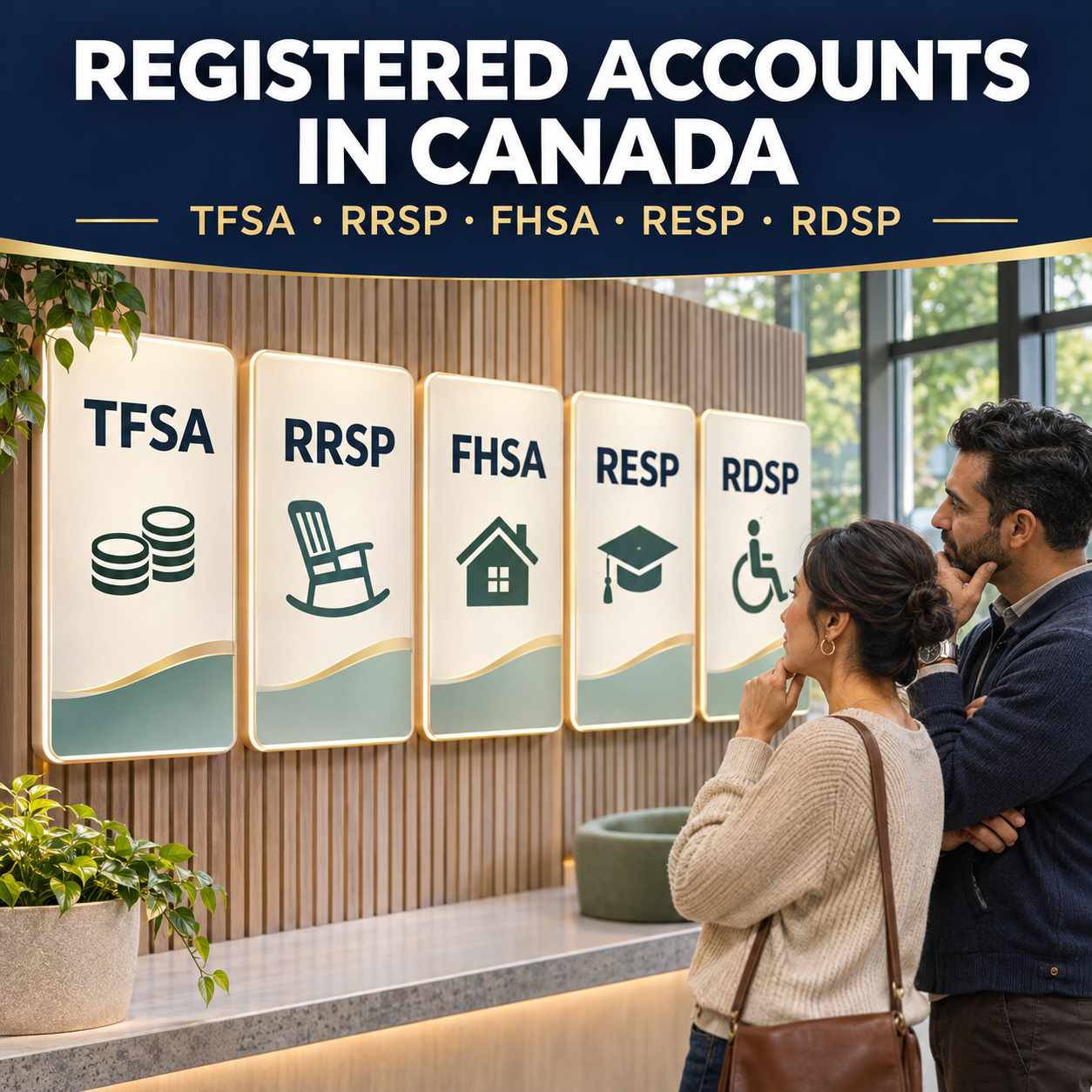


Registered accounts in Canada can make saving and investing more tax-efficient. However, the names can quickly become confusing.

A TFSA offers tax-free withdrawals. An RRSP may provide a tax deduction today, but withdrawals are generally taxable later. An FHSA combines features of both accounts for an eligible first-time home buyer. RESP and RDSP accounts serve different family goals and may receive government grants or bonds.
These accounts are not interchangeable. Each one has its own purpose, eligibility rules, contribution limits and withdrawal treatment.
This guide compares the five major Canadian registered accounts. It explains what each account is designed to do, how its tax treatment works and what questions to ask before opening or funding one.
What is a registered account?
A registered account is a savings or investment arrangement that is registered under Canadian tax law.
Registration gives the account special treatment. Depending on the account, that treatment may include:
- a tax deduction for eligible contributions
- tax-deferred or tax-free investment growth
- tax-free qualifying withdrawals
- government grants or bonds
- special rules for designated goals such as education, disability planning or a first home
Registration does not mean the investment is guaranteed. It also does not mean every withdrawal is tax-free.
The account is the legal and tax structure. The investment is what you hold inside it.
For example, a TFSA may hold cash, a guaranteed investment certificate (GIC), mutual funds, exchange-traded funds (ETFs), bonds or individual stocks. The available choices depend on the financial institution and whether the account is self-directed.
The same investment could produce a different after-tax result when held in a different account. Therefore, choosing an account and choosing an investment should be treated as two separate decisions.
Registered accounts in Canada at a glance
The following table compares the basic structure of the five accounts.
| Account | Main purpose | Contribution deduction | Growth inside the account | Typical withdrawal treatment | Government support |
|---|---|---|---|---|---|
| TFSA | Flexible saving and investing | No | Generally tax-free | Generally tax-free | None |
| RRSP | Retirement saving and tax deferral | Usually available for deductible contributions | Tax-deferred | Generally taxable | None |
| FHSA | Saving for an eligible first home | Usually available for deductible contributions | Tax-sheltered | Qualifying withdrawals are tax-free | None |
| RESP | Post-secondary education | No | Tax-sheltered while inside the plan | Contributions can be returned tax-free; EAPs are taxable to the student | CESG, CLB and some provincial incentives |
| RDSP | Long-term financial security for a DTC-approved beneficiary | No | Tax-sheltered while inside the plan | Contributions are not taxed; grants, bonds and growth are taxable portions | Disability Savings Grant and Bond |
This is a starting point, not a complete eligibility test. Family income, age, residency, contribution history and the intended withdrawal can all change the result.
TFSA: flexible saving with tax-free withdrawals
The Tax-Free Savings Account is the most flexible account in this group.
TFSA contributions are not tax-deductible. However, interest, dividends and capital gains earned inside the account are generally tax-free in Canada. Withdrawals are also generally tax-free.
A TFSA can support many goals, including:
- an emergency fund
- a future vehicle or major purchase
- a home down payment
- long-term investing
- retirement income
- savings that may need to remain accessible
The 2026 TFSA dollar limit is $7,000. However, that figure is not the same as everyone’s available contribution room.
Unused room carries forward. A withdrawal is added back to contribution room on January 1 of the following calendar year. It does not return immediately.
New Canadian residents do not receive room for years before they became residents. Contribution room generally begins accumulating only when the individual is at least 18 and is a Canadian resident for tax purposes.
CRA’s TFSA overview explains that contributions are not deductible, while income and withdrawals are generally tax-free.
The TFSA can also be useful for people who receive income-tested federal benefits. TFSA income and withdrawals generally do not affect those benefits.
Still, the account must be managed carefully. Contributing more than the available room can create a monthly tax. Always compare CRA information with personal transaction records before contributing.

RRSP: a current deduction with taxable withdrawals later
The Registered Retirement Savings Plan is designed primarily for retirement saving.
An eligible RRSP contribution may be deducted from taxable income. Investment income generally remains tax-sheltered while the money stays in the plan.
However, an RRSP is tax-deferred rather than permanently tax-free. Ordinary withdrawals are generally included in taxable income.
The financial institution normally withholds tax when money is withdrawn. That withholding is only a prepayment. The final tax depends on total income and the applicable tax rate for the year.
CRA’s RRSP overview confirms that deductible contributions may reduce tax and that payments from the plan are generally taxable.
The 2026 RRSP dollar limit is $33,810. Yet this is only the annual federal maximum used in the calculation.
Personal RRSP deduction room usually depends on prior-year earned income, unused room, pension adjustments and other factors. The Notice of Assessment is an important starting point.
Unlike a TFSA withdrawal, an ordinary RRSP withdrawal does not create new contribution room later.
The Home Buyers’ Plan and Lifelong Learning Plan may permit eligible withdrawals under special repayment rules. Those programs should not be confused with a normal taxable withdrawal.
An RRSP may be useful when the current deduction has meaningful value and the savings can remain invested for a long period. It may be less suitable for money that could be needed unexpectedly.
FHSA: saving for a first home with two tax advantages
The First Home Savings Account is designed for an eligible first-time home buyer.
FHSA contributions may be deductible. Investment growth is sheltered inside the account. A qualifying withdrawal for an eligible first home is tax-free and does not have to be repaid.
This combination makes the FHSA unusual. It can offer an RRSP-style deduction and a TFSA-style qualifying withdrawal.
The annual FHSA limit is $8,000, and the lifetime contribution limit is $40,000.
FHSA room begins only after the first account is opened. It does not accumulate automatically from age 18. Unused room that can be carried forward is also limited.
To open an FHSA, an individual must meet the age, Canadian residency and first-time home buyer conditions. The first-time buyer definition considers the current calendar year and the previous four calendar years. A spouse’s or common-law partner’s ownership may also matter.
CRA’s FHSA eligibility guide explains the opening conditions and the meaning of a first-time home buyer.
A qualifying withdrawal is tax-free. In contrast, a non-qualifying withdrawal is generally included in income.
If a home is not purchased, eligible property may generally be transferred directly to an RRSP or RRIF without an immediate tax consequence. A direct transfer does not require existing RRSP deduction room. However, the FHSA maximum participation period and transfer procedures must still be followed.
The investment choice should reflect the home-buying timeline. A person hoping to buy soon may need less market risk than someone whose purchase is many years away.
RESP: education savings with grants and bonds
The Registered Education Savings Plan is intended to help fund a beneficiary’s post-secondary education.
RESP contributions are not tax-deductible. Investment growth remains tax-sheltered while it stays in the plan.
The major attraction is government assistance.
The basic Canada Education Savings Grant generally adds 20% to the first $2,500 of annual contributions. That can provide up to $500 of basic CESG for the year. The lifetime CESG maximum is $7,200 for an eligible beneficiary.
Families with low or modest incomes may qualify for additional CESG. An eligible child from a low-income family may also receive the Canada Learning Bond. No personal RESP contribution is required to receive the CLB, and the lifetime maximum is $2,000.
The Government of Canada’s education-savings guide provides the current CESG and CLB amounts and income thresholds.
There is no annual RESP contribution limit under the current rules. The lifetime contribution limit is $50,000 per beneficiary across all RESPs.
Withdrawals require careful classification.
- A refund of the subscriber’s original contributions can generally be paid without tax.
- Educational Assistance Payments contain grants, bonds and accumulated investment income.
- EAPs are reported as taxable income to the student beneficiary.
Students often have relatively low income, so the actual tax on an EAP may be small. Still, the payment must be reported.
CRA’s RESP withdrawal guide explains the difference between contributions and taxable Educational Assistance Payments.
Before opening a plan, compare fees, investment choices, contribution schedules and withdrawal conditions. The tax rules may be the same, but provider contracts can differ.
RDSP: long-term savings with substantial government assistance
The Registered Disability Savings Plan supports the long-term financial security of a person approved for the Disability Tax Credit.
RDSP contributions are not tax-deductible. Earnings remain sheltered while they stay in the plan.
There is no annual contribution limit. The lifetime contribution limit is $200,000 for the beneficiary, and contributions may generally be made until the end of the year in which the beneficiary turns 59.
The Government of Canada may add two forms of assistance:
- Canada Disability Savings Grant: matching assistance of up to $3,500 in a year and $70,000 over the beneficiary’s lifetime
- Canada Disability Savings Bond: income-tested assistance of up to $1,000 in a year and $20,000 over the beneficiary’s lifetime, without requiring a contribution
Grant and bond eligibility normally ends after December 31 of the year the beneficiary turns 49. Carry-forward rules may allow unused entitlements from earlier eligible years to be collected later.
The federal RDSP grant and bond guide explains the 2026 matching amounts, income thresholds and carry-forward rules.
Withdrawals may include several sources of money. The original contributions are generally not taxable to the beneficiary. Grants, bonds, investment income and certain rollover amounts are generally taxable when paid.
An early withdrawal may also require repayment of recent grants and bonds. The assistance holdback rules can make withdrawal planning more complicated than it appears.
Therefore, an RDSP should usually be viewed as a long-term plan. Families should understand the beneficiary, holder, grant and bond rules before making large contributions or requesting payments.
How contribution room differs among registered accounts in Canada
The word “limit” does not mean the same thing for every account.
| Account | How the limit generally works |
|---|---|
| TFSA | Annual room is added for eligible Canadian-resident years and unused room carries forward. |
| RRSP | New room is generally based on prior-year earned income, subject to a dollar maximum and pension adjustments. |
| FHSA | Room begins after the first FHSA is opened; annual and lifetime limits apply. |
| RESP | No current annual contribution limit; a $50,000 lifetime limit applies per beneficiary. |
| RDSP | No annual contribution limit; a $200,000 lifetime limit applies per beneficiary. |
This difference matters when reading CRA account information.
A $7,000 TFSA annual limit does not mean every person can contribute $7,000. Someone may have more unused room, less room because of earlier contributions, or no room for years of non-residency.
Similarly, the annual RRSP dollar maximum is not the amount everyone can deduct. Personal deduction room must be calculated.
FHSA room is different again because opening the account starts the participation period and room accumulation.
Finally, RESP and RDSP limits must be coordinated across all plans for the same beneficiary. Opening another plan does not create a second lifetime limit.
Tax deduction, tax deferral and tax-free are not the same
Registered accounts in Canada use three different tax concepts.
Tax deduction
A deduction reduces taxable income. Eligible RRSP and FHSA contributions may provide deductions. TFSA, RESP and RDSP contributions do not.
Tax deferral
Tax is postponed while money remains in the account. RRSP growth is tax-deferred, but ordinary withdrawals are generally taxable.
RESP and RDSP growth is also sheltered inside the plan. Taxable components are generally reported by the beneficiary when paid.
Tax-free treatment
TFSA investment growth and withdrawals are generally tax-free in Canada. An FHSA qualifying withdrawal is also tax-free.
These terms should not be used interchangeably. An account that creates a deduction today may produce taxable income later.
The account does not choose the investment for you
Opening a registered account is only the first step.
Depending on the plan and provider, the account may hold:
- cash and high-interest savings products
- GICs
- bonds
- mutual funds
- ETFs
- individual stocks
- other qualified investments
The right investment depends on the goal, time horizon and ability to accept market losses.
An emergency TFSA may need liquidity and stability. A retirement RRSP with several decades remaining may be able to accept more market fluctuation. An FHSA needed next year should not automatically hold the same portfolio as an RDSP intended for long-term security.
Government registration does not protect an investor from market losses. It changes the tax treatment of the account, not the risk of the investment.
Can one person use several registered accounts in Canada?
Yes. These accounts can work together because they serve different goals.
A person might use:
- an FHSA for a first-home down payment
- a TFSA for flexible savings and long-term investing
- an RRSP for retirement and tax deferral
- an RESP for a child’s education
- an RDSP for an eligible family member’s long-term security
Using several accounts does not mean every account should receive the same amount.
Start with the goal. Then consider eligibility, available room, tax rate, government matching, time horizon and liquidity.
The next article in this series will examine which Canadian registered account may deserve priority in different situations.
Common mistakes to avoid
Treating the annual limit as personal contribution room
Annual limits are only part of the calculation. Check personal records and CRA information.
Assuming every registered-account withdrawal is tax-free
RRSP withdrawals are generally taxable. FHSA withdrawals must qualify to be tax-free. RESP and RDSP payments can contain both taxable and non-taxable amounts.
Re-contributing a TFSA withdrawal too soon
Withdrawn room normally returns the following January, not on the withdrawal date.
Opening an FHSA without checking eligibility
Home ownership and a spouse’s ownership may affect the first-time buyer test.
Contributing to an RESP without coordinating other plans
The $50,000 lifetime limit applies across all RESPs for the same beneficiary.
Ignoring the RDSP assistance holdback rules
An early withdrawal may trigger repayment of grants and bonds.
Choosing investments before defining the timeline
The account’s tax advantages cannot remove investment risk.
A practical review before contributing
Ask these questions before adding money to any registered account:
- What specific goal will this money support?
- When might the money be needed?
- Am I eligible to open and use the account?
- How much personal contribution room is available?
- Does the contribution create a tax deduction?
- Could the plan receive a grant or bond?
- What happens when the money is withdrawn?
- Will the withdrawal affect taxable income or government benefits?
- What investment risk is reasonable for the timeline?
- What records should be kept?
The best account is not necessarily the one with the largest deduction. It is the account whose rules match the purpose of the money.
Frequently asked questions
Are all registered accounts in Canada tax-free?
No. A TFSA is generally tax-free, while an RRSP mainly provides tax deferral. FHSA qualifying withdrawals are tax-free, but non-qualifying withdrawals are generally taxable. RESP and RDSP withdrawals can contain both taxable and non-taxable components.
Can I hold stocks and ETFs in every registered account?
Many registered accounts can hold qualified investments such as stocks, ETFs, mutual funds, bonds and GICs. However, the available products depend on the account issuer and plan contract.
Do RESP and RDSP contributions provide a tax deduction?
No. Their main advantages are tax-sheltered growth and potential government assistance rather than a contribution deduction.
Can I have a TFSA, RRSP and FHSA at the same time?
Yes, if you meet the eligibility rules and have available contribution room. Each account keeps its own limits and records.
Which registered account should I use first?
The answer depends on the goal, employer matching, income, first-home eligibility, grant eligibility, time horizon and need for flexibility. The next guide will compare those priorities in detail.
Johnny’s take
Registered accounts in Canada are tools, not complete financial plans.
The TFSA offers flexibility. The RRSP can move taxable income from working years into the future. The FHSA supports an eligible first-home purchase. The RESP helps fund education, while the RDSP supports long-term financial security for a person approved for the DTC.
None of these account names tells you what investment to buy. None eliminates the need to track contributions and understand withdrawals.
Start with the purpose of the money. Then choose the account whose tax and withdrawal rules support that purpose. Only after that should you decide how the money will be invested.
Continue learning
- RESP Canada: A Beginner’s Guide for Parents
- RDSP Canada: A Beginner’s Guide to Grants, Bonds and Withdrawals
- TFSA Canada: Contribution Room, Withdrawals and Investing Explained
- RRSP Canada: Contribution Room, Deductions & Withdrawals
- FHSA Canada: A Beginner’s Guide for First-Time Home Buyers
Visit Johnny’s Bookstore
Would you like to build a clearer understanding of Canadian investing, registered accounts and personal finance?
Need help?
Do you need help comparing registered accounts and understanding how their tax, contribution and withdrawal rules fit your goals? We can review the account structures, your priorities and the questions to consider before contributing or investing.
Important notice
This article provides general educational information as of November 6, 2026. Registered-account limits, eligibility requirements, tax treatment, grants, bonds and forms may change. Confirm current information with the Canada Revenue Agency, Employment and Social Development Canada and your account issuer.
This article is not personalized tax, legal, investment, disability, education or mortgage advice. The appropriate account and investment depend on eligibility, income, family circumstances, contribution room, goals, time horizon, risk tolerance and expected withdrawals.
Legal Notice & Financial Disclaimer
