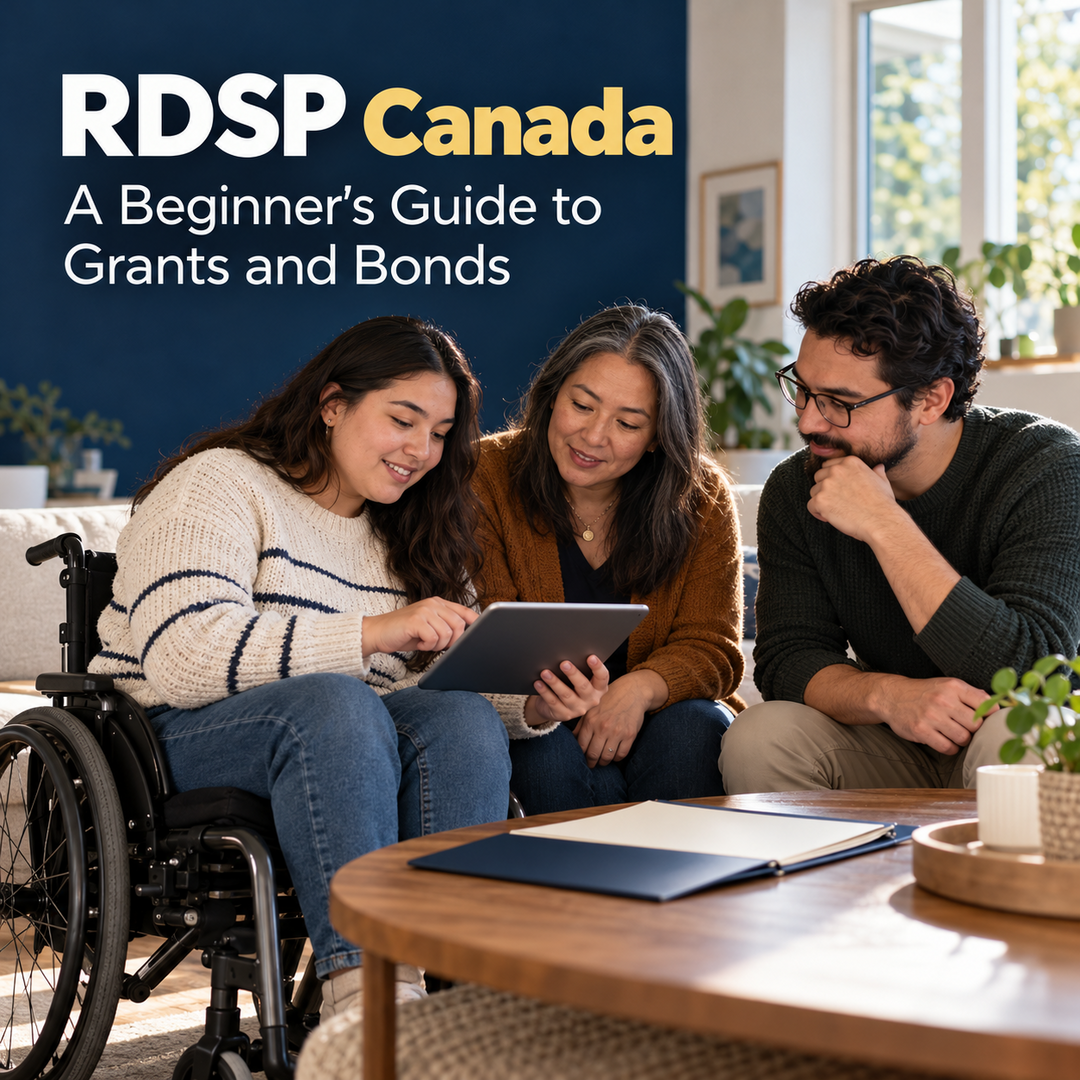


RDSP Canada rules can look complicated at first. However, the basic purpose is simple. A Registered Disability Savings Plan helps a person who qualifies for the Disability Tax Credit build long-term financial security.

The account can hold personal contributions, government grants, government bonds and investment growth. Some families may receive more from the government than they contribute themselves. Others may qualify for the Canada Disability Savings Bond without making a contribution at all.
The challenge is that opening the plan is only the first step. Families also need to understand the age limits, income rules, carry-forward opportunities and the consequences of withdrawing money too early.
This guide explains the main rules in plain English.
What is an RDSP?
A Registered Disability Savings Plan, or RDSP, is a long-term savings and investment account for a person with a disability.
The person with the disability is the beneficiary. The person or organization that opens and manages the plan is the holder. Depending on the beneficiary’s age and legal capacity, the beneficiary may also be the holder.
An RDSP is not an investment by itself. It is a registered account that can hold eligible investments offered by the financial institution. These may include savings deposits, GICs, mutual funds and other qualified investments.
Personal contributions are not tax-deductible. Still, the investments can grow on a tax-deferred basis while they remain inside the plan.
Government of Canada overview of the RDSP

RDSP Canada rules at a glance
| RDSP feature | Basic rule |
|---|---|
| Main eligibility requirement | The beneficiary must generally be approved for the Disability Tax Credit |
| Number of plans | One RDSP per beneficiary at a time |
| Annual contribution limit | No annual limit |
| Lifetime contribution limit | $200,000 per beneficiary |
| Contribution deadline | End of the calendar year the beneficiary turns 59 |
| Maximum Canada Disability Savings Grant | $3,500 in a regular year and $70,000 over a lifetime |
| Maximum Canada Disability Savings Bond | $1,000 in a regular year and $20,000 over a lifetime |
| Grant and bond deadline | End of the calendar year the beneficiary turns 49 |
| Tax deduction for contributions | No |
| Tax on private contributions when withdrawn | Generally none |
| Tax on grants, bonds and investment income | Taxable to the beneficiary when withdrawn |
| Mandatory recurring payments | Must begin by the end of the year the beneficiary turns 60 |
The lifetime contribution limit does not include government grants or bonds. However, certain rollover amounts can reduce the remaining contribution room.
Who can be the beneficiary?
To open an RDSP, the beneficiary generally must:
- Be approved for the Disability Tax Credit (DTC)
- Have a valid Social Insurance Number
- Be a resident of Canada when the plan is opened
- Be under age 60 when the plan is opened
In practice, a new plan can be opened until the end of the calendar year in which the beneficiary turns 59. A transfer from an existing RDSP can follow different rules.
The DTC is therefore the gateway to the RDSP. A medical diagnosis alone does not automatically create RDSP eligibility. The Canada Revenue Agency must approve the individual for the DTC.
CRA eligibility rules for an RDSP beneficiary
Who can open and manage the RDSP?
The answer depends on the beneficiary’s age and ability to enter into a contract.
For a child, a legal parent, guardian, tutor or another legally authorized person can usually open the plan and become its holder.
An adult beneficiary who is legally able to enter into a contract can normally open and manage their own RDSP.
If an adult is not legally able to enter into the plan, a person who is legally authorized under provincial or territorial law may act as holder.
Special federal rules may also allow a qualifying family member to open a plan when an adult beneficiary’s contractual capacity is in doubt. As of November 2, 2026, this temporary measure is scheduled to apply until December 31, 2026. Families relying on it should confirm the current rule before opening the account.
Government of Canada guidance on opening an RDSP
Who can contribute?
Anyone can contribute with the holder’s written permission. Parents, grandparents, relatives and friends may therefore help fund the plan.
However, contributors do not own a separate portion of the account. RDSP payments can only be made to the beneficiary or, after death, to the beneficiary’s estate. A contributor should not assume that unused contributions can later be refunded to them.
There is no annual contribution limit. Still, the lifetime limit is $200,000 for the beneficiary. Contributions can generally be made until the end of the year in which the beneficiary turns 59.
Only contributions made by the end of the year the beneficiary turns 49 can attract the Canada Disability Savings Grant. A large contribution after that age may still be allowed, but it will not receive a new matching grant.
How does the Canada Disability Savings Grant work?
The Canada Disability Savings Grant, or CDSG, is a government matching contribution. The amount depends on family income and the amount contributed to the RDSP.
For 2026, the government uses family income reported on the 2024 tax return.
| 2026 family income | Matching rate | Contribution needed for maximum regular grant | Maximum regular annual grant |
|---|---|---|---|
| $117,045 or less | 300% on the first $500, then 200% on the next $1,000 | $1,500 | $3,500 |
| More than $117,045 | 100% on the first $1,000 | $1,000 | $1,000 |
For example, a qualifying beneficiary in the lower income range could receive:
- A $1,500 grant on the first $500 contributed
- A $2,000 grant on the next $1,000 contributed
- A total grant of $3,500 after contributing $1,500
The lifetime CDSG maximum is $70,000. Grants can be paid until December 31 of the year in which the beneficiary turns 49.
Income thresholds are indexed and may change each year. Therefore, families should not reuse the 2026 thresholds for a future contribution without checking the updated figures.
Government of Canada grant and bond amounts for 2026
How does the Canada Disability Savings Bond work?
The Canada Disability Savings Bond, or CDSB, is designed for beneficiaries with low or modest family income.
No personal contribution is required to receive it.
| 2026 family income | Maximum regular annual bond |
|---|---|
| $38,237 or less | $1,000 |
| More than $38,237 but less than $58,523 | A partial amount that decreases as income rises |
| $58,523 or more | No bond |
The lifetime CDSB maximum is $20,000. Like the grant, the bond is only available through the end of the calendar year in which the beneficiary turns 49.
This is one reason an eligible family should consider opening an RDSP even when it cannot afford to contribute. Delaying the account may delay access to bond payments and the opportunity to review past entitlements.
Whose income is used?
The income calculation changes as the beneficiary gets older.
Until the end of the year the beneficiary turns 18, the grant and bond are generally based on the parents’ or guardians’ income information.
Beginning in the calendar year the beneficiary turns 19, the calculation generally uses the beneficiary’s income plus the income of a spouse or common-law partner, if applicable. This applies even if the adult beneficiary lives with or remains financially dependent on their parents.
The government uses tax information from two years earlier. As a result, beneficiaries should begin filing their own income tax returns for the year they turn 17. They should continue filing every year, even if they have little or no income.
If the required tax returns are missing, the beneficiary may receive only the lower matching grant and may not receive the bond.
Can unused RDSP grants and bonds be carried forward?
Yes. RDSP Canada rules allow eligible grant and bond entitlements from the previous 10 years to be carried forward.
However, the beneficiary must have met the eligibility rules in each earlier year. This generally includes DTC approval and Canadian residency for the relevant period. The amount also depends on the family income and matching rate that applied in each year.
Carry-forward amounts are generally calculated automatically. Older entitlements are used first.
In one calendar year, the plan may receive up to:
- $10,500 in CDSG, including the current-year amount
- $11,000 in CDSB, including the current-year amount
The bond does not require a contribution. By contrast, catching up unused grant entitlement requires a contribution. The amount needed depends on the matching rates attached to the unused years.
Before making a large catch-up contribution, ask the issuer or Employment and Social Development Canada how much eligible contribution is needed. Contributing more than that amount may use lifetime contribution room without attracting an additional grant.
Government of Canada carry-forward rules
A practical RDSP Canada example
Emma is 24 and is approved for the DTC. She opens an RDSP in 2026.
Her 2024 family income was $32,000. Because she is an adult, the calculation uses her own family income rather than her parents’ income.
Emma contributes $1,500 in 2026. Based on the regular 2026 matching rates, she could receive:
- $1,500 of grant on the first $500
- $2,000 of grant on the next $1,000
- $3,500 of regular CDSG in total
Her income is also below the maximum bond threshold. Therefore, she could receive a $1,000 CDSB without making any contribution for the bond itself.
If Emma had unused entitlements from earlier DTC-approved years, additional grant and bond amounts might also be available through the carry-forward rules. The exact payment would depend on her eligibility and family income in those years.
This example shows why the best contribution is not always the largest possible contribution. The first step is to identify the amount that will attract the available government grant.
What can an RDSP hold?
The investment choices depend on the financial institution and type of RDSP.
Possible choices may include:
- Savings deposits
- Guaranteed Investment Certificates
- Mutual funds
- Other qualified investments offered by the issuer
The plan may remain open for decades. Even so, a long time horizon does not mean every beneficiary should take the same level of risk.
Consider the beneficiary’s age, expected need for withdrawals, financial stability and ability to tolerate market declines. Fees also matter because they reduce the amount left to compound over time.
Most importantly, do not invest money aggressively if it may be needed soon. The 10-year repayment rule affects government benefits, but market risk can affect the entire account.
How do RDSP withdrawals work?
RDSP withdrawals are paid to the beneficiary. There are two main forms of disability assistance payments:
- Disability Assistance Payment (DAP): A single or lump-sum payment, if the plan permits it
- Lifetime Disability Assistance Payment (LDAP): A recurring payment that must continue at least annually after it begins
LDAPs must begin no later than the end of the calendar year in which the beneficiary turns 60.
Not every issuer offers the same flexibility for lump-sum withdrawals. The holder should review the plan terms before choosing a provider or requesting a payment.
Why does the 10-year repayment rule matter?
Withdrawing money can require the plan to repay government grants and bonds paid during the previous 10 years.
Under the proportional repayment rule, the plan generally repays $3 of grant or bond for every $1 withdrawn. The repayment cannot exceed the assistance holdback amount, which is broadly the grants and bonds paid into the plan during the relevant 10-year period.
Suppose the beneficiary withdraws $2,000 while at least $6,000 of recent grants and bonds remains subject to the rule. The plan may have to repay $6,000 to the government.
This does not mean a beneficiary can never withdraw before waiting 10 years. It means the family should calculate the potential repayment before making the request.
Special rules may apply when the beneficiary has a shortened life expectancy. The issuer can explain the medical documentation and withdrawal options.
Government of Canada guidance on RDSP withdrawals
How are RDSP withdrawals taxed?
An RDSP payment can contain several sources of money. Their tax treatment is different.
| Portion of the withdrawal | General tax treatment |
|---|---|
| Private contributions | Generally not taxable |
| Canada Disability Savings Grant | Taxable to the beneficiary |
| Canada Disability Savings Bond | Taxable to the beneficiary |
| Investment income and growth | Taxable to the beneficiary |
| Certain rollover amounts | Generally taxable to the beneficiary |
The issuer reports the taxable portion. A withdrawal is not simply treated as a return of contributions chosen by the holder. Payments generally contain a calculated mix of taxable and non-taxable amounts.
Tax may also be withheld when the taxable portion of payments exceeds the applicable federal credit thresholds. Withholding tax is only a prepayment. The beneficiary’s final tax depends on the full income tax return for that year.
CRA explanation of tax on RDSP payments
Does an RDSP affect disability benefits?
Opening and contributing to an RDSP generally does not reduce federal or provincial disability benefits.
However, withdrawal treatment can vary by province or territory. The federal government specifically advises residents of Quebec, New Brunswick and Prince Edward Island to check whether withdrawals may affect provincial benefits.
Rules can also change. Therefore, confirm the current treatment of both the RDSP asset and future payments under the beneficiary’s provincial support program.
What happens if DTC approval ends?
Losing DTC approval does not always mean the RDSP must close immediately.
The plan may remain open, but new grant and bond payments normally stop while the beneficiary is not DTC-approved. Contributions and withdrawals may also be affected. In addition, the repayment calculation can depend on the beneficiary’s age and the years for which DTC approval was lost.
The correct next step depends on whether the loss is temporary, whether the beneficiary may qualify again and when grants or bonds were deposited. Contact the issuer before contributing, withdrawing or closing the account.
Common RDSP Canada mistakes to avoid
First, some families wait to open the plan because they cannot afford to contribute. This can delay access to the bond, which does not require a contribution.
Second, a large deposit may be made without checking the available grant entitlement. The excess contribution may receive no matching grant while still using lifetime room.
Third, beneficiaries may stop filing tax returns because they have no taxable income. Missing returns can reduce or delay the grant and bond calculation.
Fourth, families may think personal contributions can be withdrawn first without affecting recent government money. RDSP payments and repayment rules do not work that way.
Fifth, contributors may expect to receive their money back. RDSP payments belong to the beneficiary and cannot normally be refunded to the person who contributed.
Finally, investment risk may be ignored because the account is intended for the long term. A suitable portfolio still depends on when the beneficiary may need the money.
RDSP checklist for families
- Has the beneficiary received DTC approval from the CRA?
- Does the beneficiary have a valid SIN?
- Who can legally act as the plan holder?
- Have the necessary tax returns been filed?
- What family income will be used for the current year?
- Could the beneficiary qualify for the CDSB without contributing?
- How much contribution will attract the available CDSG?
- Are unused entitlements available from the previous 10 years?
- How much lifetime contribution room remains?
- What investments and fees does the issuer offer?
- When might the beneficiary need to withdraw money?
- Could a withdrawal trigger grant or bond repayment?
- How could payments affect provincial disability benefits?
My takeaway
An RDSP can be one of Canada’s most valuable registered accounts. However, its greatest value often comes from understanding the government incentives rather than simply contributing as much as possible.
The best RDSP Canada questions are practical:
- Does the beneficiary qualify for the bond without a contribution?
- What contribution will attract the maximum available grant?
- Are there unused entitlements from earlier years?
- Can the money remain invested long enough to avoid an unnecessary repayment?
- Is the investment strategy suitable for the beneficiary’s real needs?
Start by confirming DTC approval and filing the required tax returns. Then review the grant and bond entitlements before deciding how much to contribute.
Continue Learning
- RESP Canada: A Beginner’s Guide for Parents
- How to Buy Stocks and ETFs in Canada: From Opening an Account to Your First Order
Johnny’s Bookstore
Would you like to build a clearer understanding of Canada’s financial system and investing?
Need Help?
Do you need help understanding RDSP eligibility, government incentives or long-term savings options? We can review the available information so you can make more informed decisions with confidence.
Important Notice
This article provides general financial education based on publicly available information as of November 2, 2026. RDSP eligibility, income thresholds, contribution rules, grants, bonds, carry-forward amounts, withdrawals and tax treatment can change. Confirm current information with the Government of Canada, the CRA and your RDSP issuer before acting.
This article does not recommend a particular RDSP, investment, financial institution or strategy. Individual decisions should reflect DTC eligibility, legal capacity, family circumstances, time horizon, financial situation, risk tolerance, provincial benefit rules and tax considerations.
Legal Notice & Financial Disclaimer
