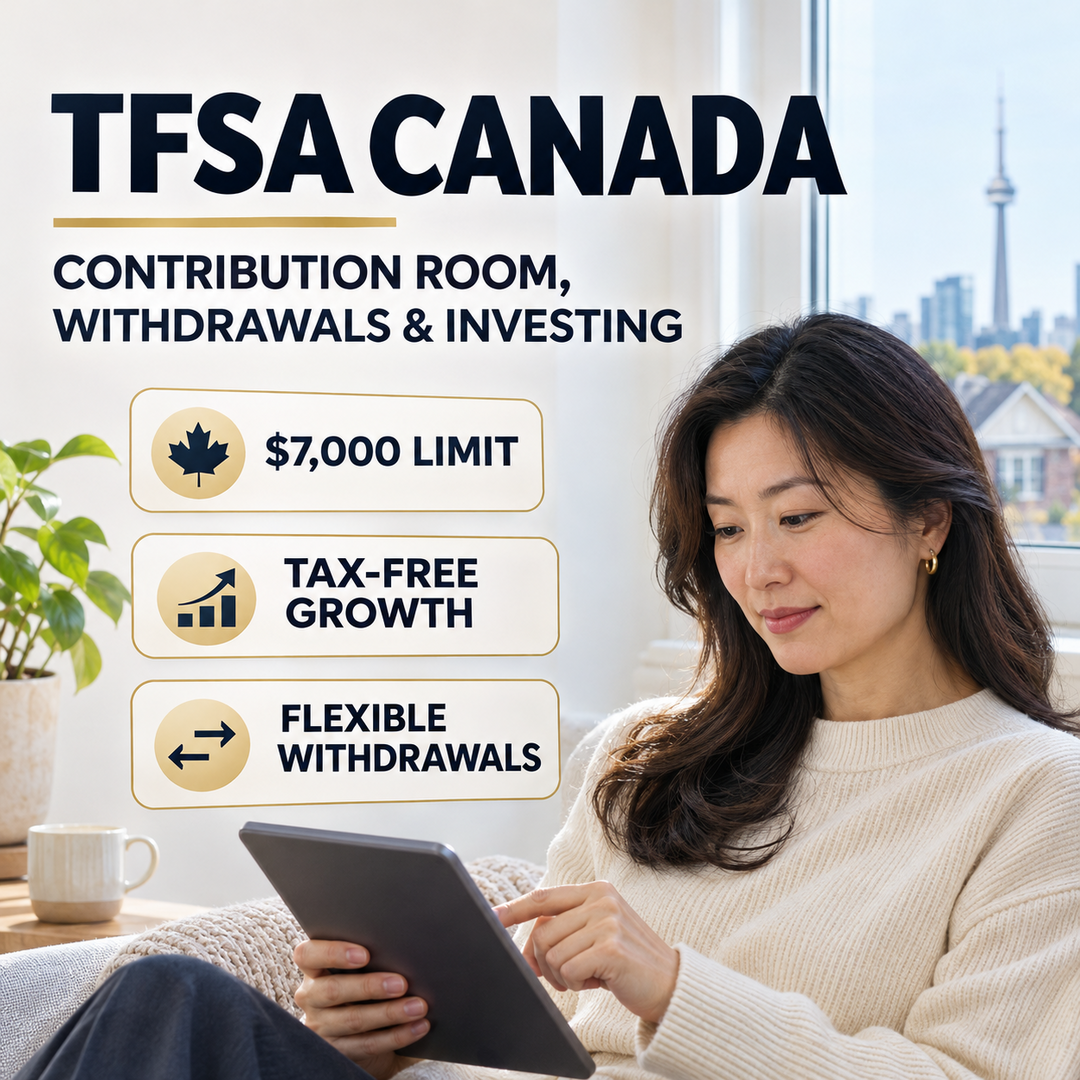


TFSA Canada rules can look simple at first. You contribute money, invest it and withdraw it without paying Canadian income tax. However, many costly mistakes happen because people misunderstand contribution room or replace a withdrawal too early.

A Tax-Free Savings Account (TFSA) is also more than a savings account. Depending on the provider, it may hold cash, Guaranteed Investment Certificates (GICs), mutual funds, stocks, bonds and Exchange-Traded Funds (ETFs).
This beginner’s guide explains who can open a TFSA, how the 2026 contribution limit works and what happens when you withdraw money. We will also look at investing, new-resident rules, overcontributions and several common mistakes.
What Is a TFSA?
The federal government introduced the TFSA in 2009. It allows eligible Canadian residents to save and invest within a registered account.
Contributions do not produce an income-tax deduction. However, interest, dividends and capital gains earned inside the account are generally tax-free in Canada. Withdrawals are also generally tax-free.
This creates an important difference between a TFSA and a Registered Retirement Savings Plan (RRSP).
| Feature | TFSA | RRSP |
|---|---|---|
| Contribution deduction | No deduction | Generally deductible when claimed |
| Investment growth | Generally tax-free | Tax-deferred |
| Regular withdrawal | Generally tax-free | Generally taxable |
| Withdrawal room restored? | Yes, the following calendar year | Generally no |
The TFSA is flexible because withdrawals can be used for any purpose. You could save for an emergency fund, a home renovation, retirement or another long-term goal.
The Canada Revenue Agency’s TFSA overview explains that contributions and investment income are generally tax-free, including when money is withdrawn.

A TFSA Is an Account, Not an Investment
The name “Tax-Free Savings Account” sometimes causes confusion. It sounds like one specific bank account that pays interest. In reality, a TFSA is a registered account structure.
Think of it as a container. The tax rules apply to the container, while the investments inside determine how the money may grow and how much risk you take.
One person may use a TFSA savings account for a short-term emergency fund. Another may hold a diversified ETF portfolio for retirement. Both have a TFSA, but their investments and risk levels are very different.
Opening a TFSA does not automatically invest your money. If cash is deposited but no investment is selected, it may remain in cash. Always check what the account actually holds.
Who Can Open a TFSA in Canada?
To open a TFSA, you generally must meet all three conditions:
- You are a resident of Canada for income-tax purposes.
- You are at least 18 years old.
- You have a valid Social Insurance Number (SIN).
You do not need employment income to open or contribute to a TFSA. A student, stay-at-home spouse or retiree may still accumulate contribution room if the eligibility conditions are met.
In some provinces and territories, you must be 19 to enter into a financial contract. If so, you may need to wait until age 19 to open the account. However, the contribution room from the year you turned 18 can still carry forward.
CRA’s TFSA eligibility page confirms the residency, age and SIN requirements. It also explains the special situation for provinces where the age of majority is 19.
What Is the TFSA Canada Limit for 2026?
The TFSA dollar limit for 2026 is $7,000. This is the annual amount added for an eligible person. It is not necessarily the maximum that person can contribute.
Your available TFSA contribution room may include three parts:
Current-year dollar limit + unused room from earlier years + last year’s withdrawals
Contributions already made during the current year must then be deducted.
Suppose Maria had $5,000 of unused room at the end of 2025. She made no withdrawals in 2025. Her room at the beginning of 2026 would be:
| Calculation | Amount |
|---|---|
| 2026 annual limit | $7,000 |
| Unused room carried forward | $5,000 |
| Available room for 2026 | $12,000 |
Unused room does not expire. It can carry forward until you use it.
CRA’s contribution-room calculator confirms the $7,000 limit for 2026 and explains the contribution-room formula.
One Limit Applies Across All Your TFSAs
You can have more than one TFSA. For example, you might have a savings TFSA at a bank and an investment TFSA at a brokerage.
However, opening another account does not create more room. Your contribution limit applies to all your TFSAs combined.
Assume your available room is $7,000. You contribute $4,000 to one TFSA and $3,000 to another. You have used the full $7,000, even though neither account individually received $7,000.
This is one reason to keep your own records. Financial institutions report TFSA activity to the CRA after the year ends. Therefore, the amount shown in CRA My Account may not include your most recent contributions.
How TFSA Canada Room Works for New Residents
New residents do not receive contribution room for years before they became residents of Canada.
If you become a Canadian resident for income-tax purposes at age 18 or older, your room starts in the year you become a resident. It does not begin in 2009 simply because the TFSA program existed then.
For example, Daniel became a resident of Canada in October 2026. He was 35 years old and had never lived in Canada before. His 2026 room would generally begin with the $7,000 annual limit, not the cumulative room available to someone who had been eligible since 2009.
The annual limit is not divided by the number of months remaining in the year. However, tax residency is a legal determination. The immigration date and tax-residency date are not always identical in every situation.
CRA’s guide for contributing to a TFSA provides a new-resident example and warns that room exists only for years in which the person was a Canadian resident.
Are TFSA Contributions Tax-Deductible?
No. A TFSA contribution does not reduce your taxable income.
If you earn $60,000 and contribute $6,000 to your TFSA, you still report the same income. The contribution does not create a deduction like an RRSP contribution may.
The benefit comes later. Qualifying investment growth and withdrawals are generally not included in Canadian taxable income.
This makes the TFSA useful for many people, including those who expect to be in a higher tax bracket later. Still, the right account depends on your goals, current income, future income and access to other registered plans.
How Do TFSA Withdrawals Work?
You can generally withdraw money from a TFSA when you need it. The withdrawal is usually not included in your Canadian taxable income.
The amount withdrawn also creates new contribution room. However, that room is not available immediately. It returns on January 1 of the next calendar year.
This timing rule causes one of the most common TFSA Canada mistakes.
Suppose you have no unused room left and withdraw $10,000 in June 2026. You cannot automatically put the same $10,000 back in December 2026. The withdrawn amount becomes new room on January 1, 2027.
If you still had at least $10,000 of separate unused room, you could contribute in December. Without that room, the contribution could create an excess amount.
CRA’s TFSA withdrawal guidance clearly states that a withdrawal is added back as contribution room in the following calendar year.
A Practical TFSA Withdrawal Example
Let us look at a complete example.
At the start of 2026, Priya has $12,000 of available room. She contributes $8,000 in February. Her remaining room is $4,000.
In August, she withdraws $5,000 for an emergency.
| 2026 activity | Contribution room effect |
|---|---|
| Starting room | $12,000 |
| February contribution | -$8,000 |
| Room remaining | $4,000 |
| August withdrawal | No immediate increase |
Priya can still contribute up to $4,000 during 2026. The $5,000 withdrawal does not return until January 1, 2027.
At that time, her new room will include:
- the 2027 annual TFSA dollar limit;
- the $5,000 withdrawn in 2026; and
- any unused room remaining from 2026.
The 2027 annual limit should be confirmed once the federal government publishes it.
What Investments Can a TFSA Hold?
The investments available depend on your financial institution and the type of TFSA you open. Qualified investments can generally include:
- cash and deposits;
- Guaranteed Investment Certificates (GICs);
- government and corporate bonds;
- mutual funds;
- most securities listed on a designated stock exchange;
- Exchange-Traded Funds (ETFs); and
- Real Estate Investment Trusts (REITs).
Not every investment is permitted. Closely connected or non-qualified investments can trigger significant tax consequences.
CRA’s qualified-investment guidance lists money, GICs, bonds, mutual funds and most securities on designated exchanges among common qualified investments.
How Should You Invest Inside a TFSA?
The account’s tax treatment does not decide the appropriate investment. Your goal and time horizon matter first.
Money needed soon may be better suited to cash, a high-interest savings product or a short-term GIC. Long-term money may have more time to recover from market declines and could be invested differently.
Consider these questions before choosing an investment:
- When will I need the money?
- How much short-term loss can I accept?
- Is this money for emergencies or a long-term goal?
- Do I understand the fees and risks?
- Is the investment diversified?
The letters “TFSA” do not make a risky investment safe. They only describe the account’s Canadian tax structure.
Investment Growth Does Not Use Contribution Room
Suppose you contribute $7,000 and your investments grow to $10,000. The $3,000 gain does not use additional room.
If you later withdraw the full $10,000, that amount will generally be added to your contribution room the next calendar year. In this way, investment growth can increase the room recovered after a withdrawal.
The opposite is also true. If a $7,000 investment falls to $4,000 and you withdraw it, only the $4,000 withdrawal is added back next year. The $3,000 investment loss does not create new room.
CRA’s contribution guidance confirms that investment losses do not count as withdrawals and do not restore contribution room.
Can Your Spouse Give You Money for Your TFSA?
Yes. One spouse or common-law partner may give the other money to contribute to their own TFSA.
The account must remain in the receiving spouse’s name. That person uses their own contribution room and owns the TFSA. The contribution cannot exceed their available room.
According to the CRA, income earned from money gifted to a spouse for their TFSA is not attributed back to the spouse who provided it. This can allow a couple to use both partners’ available room.
However, one spouse cannot contribute directly to the other person’s TFSA as if it were a spousal RRSP. The money should be gifted, and the TFSA holder makes the contribution to their own account.
CRA’s contribution page explains the option to give money to a spouse or common-law partner for their own TFSA.
How Do You Transfer a TFSA to Another Institution?
Ask the receiving financial institution to complete a direct TFSA transfer.
Do not assume that withdrawing the money yourself and depositing it into a new TFSA produces the same result. The new deposit counts as a contribution. If you do not have enough room, you could overcontribute.
A direct transfer between your TFSAs generally does not use contribution room. The institutions may charge a transfer fee, so ask about the cost before proceeding.
The process can take time. If investments must be sold before the transfer, you may also be out of the market while the transfer is completed.
What Happens If You Overcontribute?
An excess TFSA amount is generally taxed at 1% per month for each month it remains in the account.
For example, a $5,000 excess amount could create a $50 tax for each month it remains. Removing the excess quickly may stop additional monthly tax, but it does not erase tax already incurred.
Do not wait for the CRA to contact you. CRA account information may be delayed because issuers report activity after year-end.
If an overcontribution occurs, review the CRA instructions and remove the excess as soon as possible. You may also need to file Form RC243, Tax-Free Savings Account Return.
CRA’s overcontribution page explains the 1% monthly tax and reporting requirements.
What If You Become a Non-Resident?
You can generally keep an existing TFSA after becoming a non-resident of Canada. Canadian tax usually does not apply to the income and withdrawals in the account.
However, new TFSA contribution room does not accumulate for a full calendar year in which you are a non-resident. Contributions made while non-resident are generally subject to a 1% tax per month while they remain in the account.
Your new country of residence may not recognize the TFSA’s tax-free status. It could tax the account’s income or require additional reporting.
CRA’s non-resident TFSA guidance explains both the Canadian contribution penalty and the possibility of tax in the country of residence.
Does a TFSA Affect Government Benefits?
TFSA income and withdrawals generally do not affect federal income-tested benefits and credits.
Examples listed by the CRA include:
- Old Age Security (OAS);
- Guaranteed Income Supplement (GIS);
- Canada Child Benefit (CCB);
- GST/HST credit; and
- Canada Workers Benefit.
This can be especially helpful for lower-income retirees. A taxable RRSP or RRIF withdrawal may affect net income. A regular TFSA withdrawal generally does not.
Benefit programs can have their own rules. Always confirm the treatment of a specific provincial, territorial or private program.
CRA’s TFSA overview identifies federal benefits and credits that are not affected by TFSA income or withdrawals.
Is Everything Inside a TFSA Completely Tax-Free?
Not always.
Foreign dividends may be subject to tax withheld by the foreign country. Because the income sits inside a TFSA, that foreign tax generally cannot be claimed as a Canadian foreign tax credit.
Tax may also arise from excess contributions, non-resident contributions, non-qualified or prohibited investments, and advantages connected to the account. A TFSA trust carrying on a business may face tax as well.
These situations do not change the TFSA’s main benefit. They simply show why “tax-free” should not be read as “every transaction is exempt from every possible tax.”
CRA’s foreign-tax-credit folio notes that foreign taxes on income earned through a TFSA are not counted for a Canadian foreign tax credit.
Common TFSA Canada Mistakes
The most frequent mistakes are usually avoidable.
Treating the annual limit as your personal room: Your actual room depends on eligibility, unused amounts, withdrawals and current-year contributions.
Replacing a withdrawal in the same year: The withdrawal returns as room on January 1 of the next year, unless you already have separate unused room.
Adding the limit for every TFSA: One personal limit applies across all your accounts.
Trusting CRA My Account without checking recent activity: Contribution information may not update immediately.
Assuming newcomers receive room back to 2009: Room begins only for eligible years of Canadian tax residency.
Making your own transfer between institutions: A withdrawal and new deposit can accidentally create an overcontribution.
Forgetting about non-residency: Moving abroad can change contribution and foreign-reporting rules.
Leaving the account entirely in cash by accident: Opening a TFSA and choosing an investment are separate decisions.
TFSA Checklist for Beginners
Before contributing, ask yourself:
- Am I a Canadian resident for income-tax purposes?
- Have I confirmed my available room using my own records?
- Have I included contributions to every TFSA I own?
- Did I make a withdrawal last year or this year?
- Does the investment match my goal and time horizon?
- Do I understand the fees and potential losses?
- Am I using a direct transfer when changing institutions?
- Could foreign withholding or non-residency rules apply?
This short review can prevent a small misunderstanding from becoming a tax problem.
Johnny’s Takeaway
A TFSA is one of Canada’s most flexible financial accounts. It can hold short-term savings, long-term investments or a combination of both. Investment growth and withdrawals are generally tax-free in Canada, and unused room carries forward.
However, flexibility does not remove the need for record-keeping. Know your personal contribution room. Remember that withdrawals return as room the following year. Then choose investments based on the purpose of the money, not simply because the account is called a TFSA.
Used carefully, the TFSA can support many different stages of life without creating taxable income when money is withdrawn.
Continue Learning
- RESP Canada: A Beginner’s Guide for Parents
- RDSP Canada: A Beginner’s Guide to Grants, Bonds and Withdrawals
- How to Buy Stocks and ETFs in Canada: From Opening an Account to Your First Order
Johnny’s Bookstore
Would you like to build a clearer understanding of Canada’s financial system and investing?
Need Help?
Do you need help understanding your registered accounts and investment options? We can review your current situation and goals so you can make more informed decisions with confidence.
Important Notice
This article is intended for general financial education and reflects information available as of November 3, 2026. Contribution limits, residency rules and tax treatment can change. Confirm current information through the Canada Revenue Agency and consider professional advice for your circumstances.
This article does not recommend a particular account, investment product, financial institution or strategy. Individual decisions should reflect personal goals, time horizon, financial circumstances, eligibility, risk tolerance and tax situation.
Legal Notice & Financial Disclaimer
