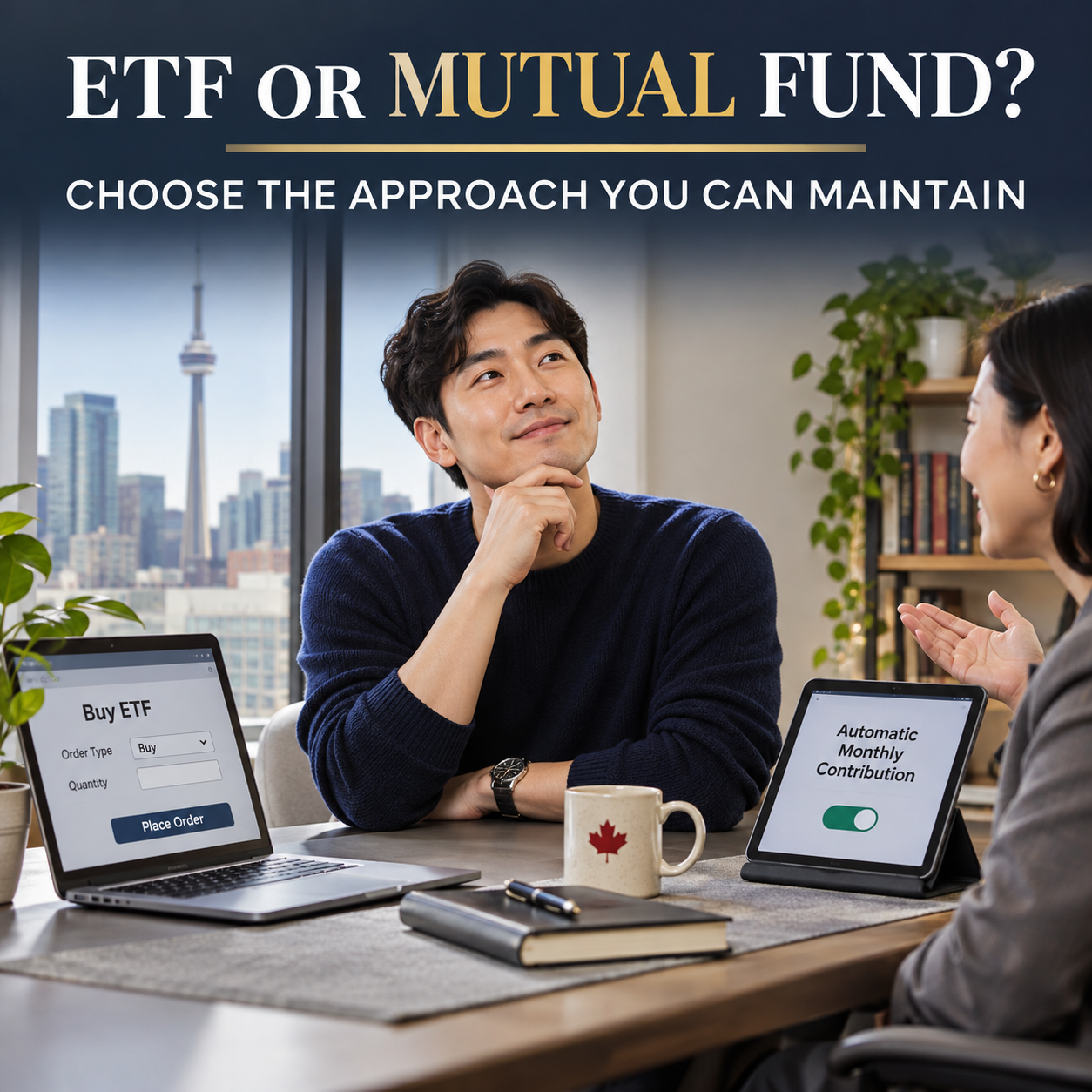


ETF or mutual fund? The better choice depends less on the label and more on how you invest. Your need for advice, comfort with trading, contribution schedule and willingness to rebalance can matter more than the product name.

The short answer
An ETF may suit an investor who wants control, intraday trading and a self-directed account. A mutual fund may suit someone who values automatic investing, simple purchases and an advice relationship.
However, neither structure is automatically safer, cheaper or better performing. Both can hold similar investments. Both can also use active or passive management.
The right question is not, “Which product wins?” It is, “Which approach can I understand and maintain?”
ETF or Mutual Fund at a glance
| If this sounds like you | An ETF may fit | A mutual fund may fit |
|---|---|---|
| I want to place my own trades | ✓ | |
| I want to use limit orders | ✓ | |
| I prefer automatic dollar-based purchases | Sometimes | ✓ |
| I want the price only once each business day | ✓ | |
| I want an adviser connected to the purchase | Sometimes | Often |
| I want a self-directed, low-cost approach | Often | Sometimes |
| I want active management | Available | Available |
| I want index investing | Available | Available |
This table is only a starting point. The fund’s mandate, risk, holdings and total cost still matter.
Start with the investor, not the product
Before choosing an ETF or mutual fund, define what the money is meant to do.
Ask yourself:
- What is the goal?
- When will I need the money?
- How much loss can I financially handle?
- How much volatility can I emotionally tolerate?
- Do I want advice?
- Will I invest automatically?
- Can I rebalance the portfolio myself?
These questions shape the portfolio. The ETF or mutual fund is only the container used to hold the investments.
The Ontario Securities Commission’s investor education site recommends considering goals, time horizon, risk, fees, taxes and your understanding of the investment when choosing an asset mix.
How much control do you want?
ETFs trade on an exchange throughout the day. You choose the order type, number of units and price conditions. That flexibility can be useful.
However, flexibility creates responsibility. You must understand bid and ask prices. You also need to avoid trading at an unreasonable price during a volatile market.
Traditional mutual funds work differently. You normally place an order in dollars or units. The trade is then completed at the fund’s next calculated net asset value.
You do not control the intraday price. On the other hand, you do not need to watch the market or choose a limit price.
Do you want to manage the account yourself?
A self-directed investor may prefer ETFs. Many discount brokerages offer broad ETF menus, research tools and low trading costs.
Still, buying an ETF is the easy part. You must also choose the asset mix, add new money, reinvest cash and rebalance when the portfolio drifts.
A mutual fund may come through an adviser, bank or workplace plan. In some arrangements, the adviser helps with planning and portfolio reviews. In others, the service may be limited.
Never assume a mutual fund automatically includes comprehensive advice. Ask what service you receive and how the adviser is paid.
Your behaviour during a market decline matters
ETFs make trading easy. Prices appear throughout the day. That transparency can help disciplined investors.
It can also tempt someone to react to every headline. Frequent changes may turn a long-term plan into short-term speculation.
Mutual funds are priced once per business day. The structure can create a little distance from intraday noise. Yet a mutual fund investor can still panic and sell at the wrong time.
Therefore, product structure does not create discipline. Your process does.
Compare the total cost, not only the MER
ETFs often have lower MERs than comparable mutual funds. However, that is not a universal rule.
An ETF investor may also face commissions, bid-ask spreads, currency conversion and account fees. A managed ETF portfolio can add a separate advice fee.
A mutual fund may include management, administration and dealer compensation in its expenses. Some series are designed for fee-based accounts, while others include embedded compensation.
The Canadian Investment Regulatory Organization explains that investors may face fund expenses, commissions, spreads, advice fees, currency costs and account charges. Compare the full dollar cost of the arrangement.
For a detailed breakdown, read ETF Fees in Canada: MER, Commissions and Other Costs.
Automatic contributions can change the answer
Many mutual funds allow automatic purchases for a fixed dollar amount. This can make monthly investing simple.
Some brokerages now offer recurring ETF purchases and fractional units. Others do not. If fractional trading is unavailable, cash may remain uninvested until you can buy a full unit.
Small purchases also make commissions more important. A $9.99 charge on a $200 order is almost 5%. In that situation, a no-commission ETF or no-load mutual fund may be more practical.
Automation is valuable because it turns a good intention into a routine. Choose a structure your platform can support efficiently.
Active and passive are separate decisions
An ETF is not automatically passive. A mutual fund is not automatically active.
Both structures can track an index. Both can also use a manager to select investments or adjust the portfolio.
Therefore, make two decisions:
- Do I want active or passive management?
- Do I want that strategy delivered through an ETF or mutual fund?
Keeping those questions separate prevents a common mistake. It also makes cost and performance comparisons more useful.
The Ontario Securities Commission notes that investors can combine active and passive approaches. Your choice should reflect your goals, preferences and ability to stay invested.
Rebalancing is part of the investment style
A portfolio changes as markets move. Stocks may grow faster than bonds. One region may become too large.
If you own several ETFs, you may need to calculate trades and rebalance the account. New contributions can help, but the work remains yours.
Some mutual fund programs include automatic rebalancing. Asset-allocation ETFs can also rebalance internally. Therefore, simplicity is available in both structures.
The important point is maintenance. A portfolio you never rebalance may no longer match the risk you originally chose.
Tax and account type come after the plan
There is no universal rule that an ETF belongs in a TFSA or a mutual fund belongs in an RRSP.
Either product can be held in a TFSA, RRSP, FHSA, RESP or non-registered account when the investment is eligible. The tax result depends on the account, distribution type, foreign withholding and your personal situation.
In a non-registered account, recordkeeping also matters. Reinvested distributions, return of capital and purchases can affect the adjusted cost base.
Choose the investment plan first. Then decide which account and product structure support it.
When an ETF may fit your investment style
An ETF may be a good fit when:
- You are comfortable using a self-directed brokerage.
- You understand market and limit orders.
- You want intraday trading flexibility.
- You will compare spreads and total costs.
- You can build and rebalance a portfolio.
- You will not react to every market headline.
- Your platform supports efficient recurring purchases.
The word “may” matters. A low-cost ETF can still be a poor choice if it does not match the goal or risk level.
When a mutual fund may fit your investment style
A mutual fund may be a good fit when:
- You prefer automatic dollar-based contributions.
- You do not want to place exchange trades.
- You value a professional advice relationship.
- Your workplace plan offers a useful fund menu.
- You want a program that handles rebalancing.
- You understand the fund series and total cost.
- The strategy matches your goal and risk tolerance.
A mutual fund is not automatically expensive or actively managed. Review the specific fund and series before deciding.
When using both can make sense
The choice does not have to be all or nothing.
An investor might use a broad ETF as the core of a portfolio. An actively managed mutual fund could fill a specific role. Another investor may hold mutual funds in a workplace plan and ETFs in a self-directed TFSA.
Using both can be reasonable when every holding has a clear purpose. It becomes a problem when the combination creates duplication, confusion or unnecessary cost.
Five investor examples
| Investor | What matters most | Possible direction |
|---|---|---|
| Disciplined DIY investor | Control, low ongoing cost and rebalancing | Broad ETFs may fit |
| New investor who wants guidance | Planning, explanations and accountability | An advised mutual fund or managed portfolio may fit |
| Small monthly contributor | Automation and low transaction cost | No-commission recurring ETFs or mutual funds may fit |
| Workplace-plan member | Available menu and employer program | Mutual funds may be the practical choice |
| Investor who wants simplicity | One decision and automatic rebalancing | An asset-allocation ETF or balanced mutual fund may fit |
These are examples, not recommendations. Two people with the same income can make different reasonable choices.
Common mistakes when choosing an ETF or Mutual Fund
Choosing only by the lowest fee
Cost matters. However, a cheap product that you misunderstand can become expensive through poor decisions.
Assuming mutual funds always include advice
The fund pays for portfolio management. Personal advice depends on the account and service arrangement.
Assuming every ETF is passive
Active ETFs are widely available. Read the investment objective and strategy.
Treating more holdings as better diversification
Ten funds can own many of the same companies. Look through to the underlying assets.
Chasing last year’s winner
Past performance can attract investors after the strongest period has already passed. Start with the plan, not the performance table.
Changing products without changing the process
Moving from mutual funds to ETFs will not automatically fix emotional trading, poor diversification or missing goals.
A simple decision checklist
Before choosing an ETF or mutual fund, answer these questions:
- What job will this investment do?
- When will I need the money?
- What decline can I tolerate without selling?
- Do I want to manage the account myself?
- Do I understand how orders are placed?
- Will I invest monthly or occasionally?
- Can the platform automate my plan?
- Who will rebalance the portfolio?
- What is the total cost in dollars?
- What advice or service is included?
- Does the investment duplicate something I already own?
- Can I explain why I chose it in one sentence?
If the final answer is unclear, pause. A simple plan you understand is usually stronger than a complicated collection of products.
Johnny’s take
I do not think investors need to join a team called ETF or a team called mutual fund. Both are tools.
The better choice is the one that supports good behaviour. It should also fit your budget, account and desired level of help.
If you enjoy managing the details, an ETF portfolio may feel natural. If automation and guidance keep you consistent, a mutual fund arrangement may be worth the cost. A combination can also work.
Choose the approach you can follow in a difficult market. That is when the difference becomes real.
Related reading
- ETF Fees in Canada: MER, Commissions and Other Costs
- Are Mutual Funds Safer Than ETFs in Canada?
- Active ETFs vs Mutual Funds in Canada
- ETF vs. Mutual Funds: Which Investment Is Right for You in Canada?
Visit Johnny’s Bookstore
Would you like to learn more about Canadian investing, registered accounts and personal finance?
Need help?
If you would like help comparing investment structures or building an approach that fits your goals and comfort level, feel free to contact me.
Important notice
This article is for general educational purposes only. It does not provide personalized investment, tax or legal advice. Investment costs, product features and tax rules can change. Review the latest disclosure documents and speak with a qualified professional when needed.
