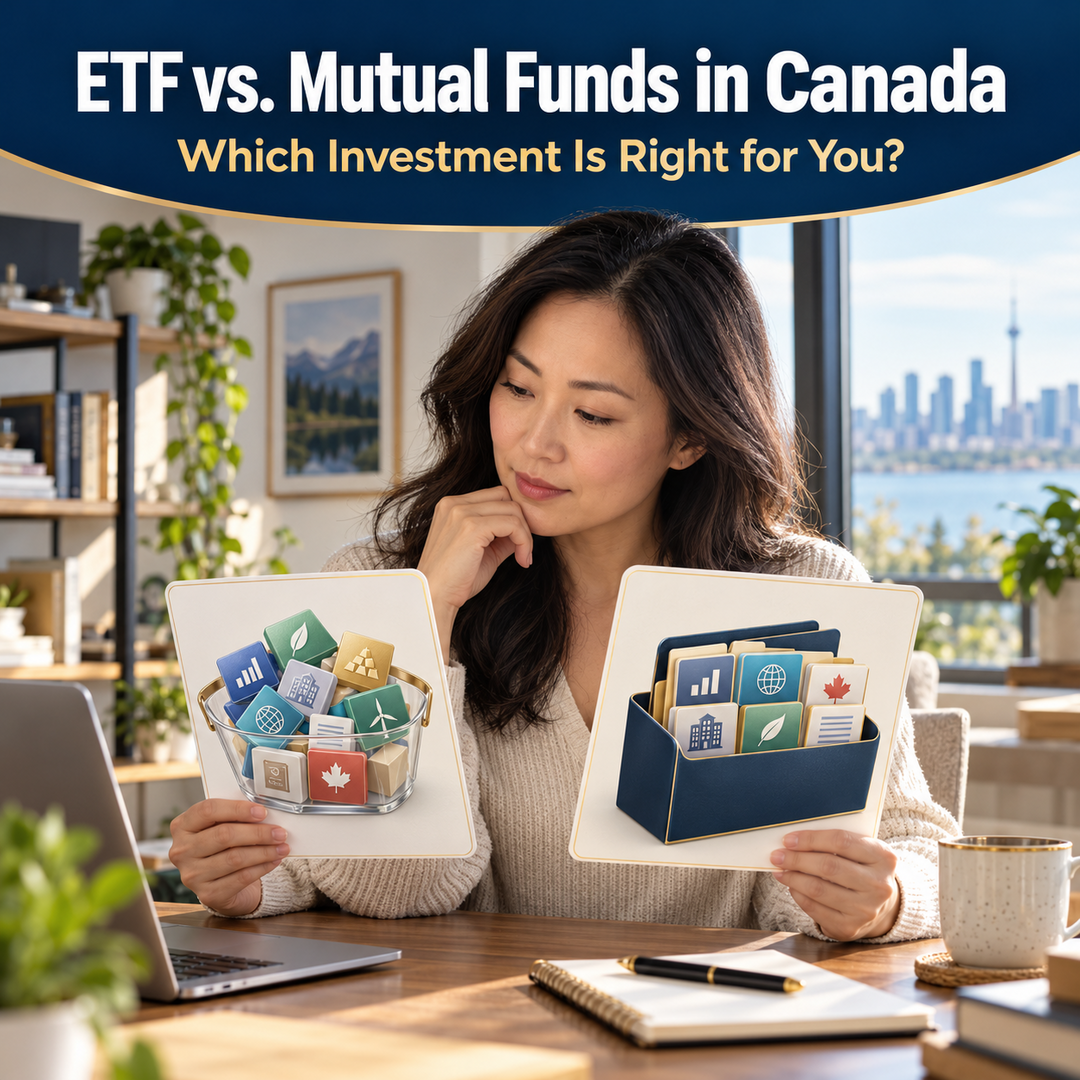


When comparing ETF vs. mutual funds in Canada, one question comes up more than almost any other:

“Is an ETF better, or is a mutual fund better?”
These days, ETFs are often promoted for their low costs. Mutual funds, meanwhile, may be presented as professionally managed investments that come with advice.
That can lead to an overly simple conclusion:
ETFs are inexpensive and therefore better.
Mutual funds cost more but come with professional management.
In reality, the choice is not that simple.
Some ETFs are actively managed. Some mutual funds track an index. Costs vary widely from one product to another.
Owning an ETF does not automatically mean that you must invest entirely on your own. Likewise, owning a mutual fund does not guarantee that you will receive ongoing financial advice.
So, instead of asking which product is always better, a more useful question is:
“How do I want to manage investment decisions, costs, service and my own behaviour?”
In this article, we will compare ETFs and mutual funds by looking beyond fees and considering the full investing experience.
ETF vs. Mutual Funds at a Glance
Both ETFs and mutual funds can hold many investments within a single fund. However, the way they trade and the experience they offer can be different.
| Feature | ETF | Mutual fund |
|---|---|---|
| How it trades | Usually bought and sold on an exchange like a stock | Usually purchased or redeemed through a fund company or dealer |
| Price | Can change throughout the trading day | Usually transacts at a net asset value calculated once per day |
| Management style | Can be passive or active | Can be active or passive |
| Cost | Varies by product | Varies by product and series |
| Other trading costs | May include commissions, bid-ask spreads and currency-conversion costs | Depends on the fund, series and account structure |
| Automatic investing | Availability depends on the platform and product | Regular contribution plans are often easy to arrange |
| Professional advice | Depends on the service arrangement | Depends on the distribution channel and service arrangement |
The most important point is this: the label alone does not tell you the cost, risk or level of service.
You still need to examine the actual investment and account structure.

What Is an ETF?
ETF stands for exchange-traded fund. It is an investment fund that trades on a stock exchange.
Although ETFs are often called index funds, not every ETF follows an index. It is more accurate to think of an ETF as a fund structure that trades on an exchange.
A single ETF may hold:
- Canadian stocks
- U.S. stocks
- Global stocks
- Bonds
- Short-term bonds
- Commodities
- A specific industry
- Investments from one country
- A combination of different asset classes
One ETF may own hundreds of companies. Another may concentrate on a narrow industry or theme.
For that reason, you should not automatically assume that an ETF provides broad diversification. You need to check what it actually owns.
Do All ETFs Track an Index?
No. This is an important distinction.
Many ETFs use passive management and aim to follow a particular index. For example, an ETF may be designed to reflect the performance of a broad stock market.
However, actively managed ETFs also exist. With an active ETF, the portfolio management team can make decisions about which investments to hold and how much to allocate to each one.
Therefore, ETF does not always mean passive investing.
Better questions include:
- What index or strategy does the ETF follow?
- Is it active or passive?
- What does it hold?
- How much does it cost?
- What role would it play in my portfolio?
Is Low Cost the Biggest Advantage of an ETF?
Many ETFs provide market exposure at a relatively low cost. Broad-market index ETFs, in particular, may have lower management fees than many other investment products.
Still, it would be a mistake to assume that every ETF is inexpensive.
Possible ETF costs include:
- Management fees
- Fund expenses
- The management expense ratio, or MER
- Trading commissions
- Bid-ask spreads
- Currency-conversion costs
- Account fees
An ETF that follows a specialized theme or complex strategy may cost considerably more than a simple broad-market ETF.
When comparing ETF costs, do not stop at the single number shown in an advertisement.
What Is the Bid-Ask Spread?
Because ETFs trade on an exchange, there can be a difference between the price at which you can buy and the price at which you can sell. This is called the bid-ask spread.
For example, suppose an ETF is quoted at:
- Ask price: $20.05
- Bid price: $20.00
That difference can affect both the trading experience and your actual cost.
The spread may become more important when an ETF has lower trading activity or when markets are volatile. This is another reason why comparing only the MER does not tell the full story.
What Is a Mutual Fund?
A mutual fund pools money from many investors and manages it according to a stated investment objective and strategy.
Depending on the fund, it may hold:
- Stocks
- Bonds
- Cash or short-term investments
- A combination of asset classes
Mutual funds also come in many forms, including:
- Canadian equity funds
- Global equity funds
- Bond funds
- Balanced funds
- Asset-allocation funds
- Sector funds
- Index funds
The words “mutual fund” alone do not reveal the investment’s risk or cost. You need to look at what the fund owns and how it is managed.
Are All Mutual Funds Actively Managed?
No.
Many mutual funds use active management. Their portfolio teams decide which investments to buy or sell and how to adjust the fund’s asset mix.
However, index mutual funds also exist. These funds may aim to follow a particular market index rather than select securities actively.
Therefore, mutual fund does not always mean active management.
Just as with an ETF, you need to review the actual investment strategy.
Is Professional Management the Main Advantage of a Mutual Fund?
Professional management can be an important feature, but two different services are often confused.
The first is fund management. A portfolio manager and investment team manage the assets held inside the fund.
The second is personal investment advice. Someone reviews your income, goals, time horizon and risk profile to help determine an appropriate direction for you.
These are not the same service.
A professionally managed mutual fund does not automatically provide ongoing personal financial advice. On the other hand, an investor who uses ETFs may still receive professional advice through a separate service arrangement.
Ask the following questions separately:
- Who manages the fund?
- Who advises me?
- What services are included?
- How am I paying for those services?
How Should You Compare the Cost of ETFs and Mutual Funds?
Many investors begin with the MER. That is a useful starting point, but the full cost can include much more.
Fund-level costs may include:
- Management fees
- Fund operating expenses
- MER and other disclosed expenses
Trading-related costs may include:
- Trading commissions
- Bid-ask spreads
- Currency-conversion costs
Account-related costs may include:
- Annual account fees
- Administration fees
- Transfer fees
- Other service charges
Advice-related costs may include:
- Compensation included in the fund structure
- A separate advisory fee
- An account-based management fee
- Other service costs
For example, an ETF may have an MER of 0.20%, while a mutual fund may have an MER of 2%. That difference matters. However, it does not automatically answer every question.
You also need to understand what services you receive and what your total cost will be.
High ongoing fees can significantly reduce an investor’s net return over time. At the same time, judging an entire investment strategy by cost alone can overlook other important factors.
Why Investment Costs Deserve More Attention in 2026
Canada has been moving toward stronger investment-fund cost reporting. As the enhanced reporting framework is introduced, investors may see fund costs shown more clearly in dollar terms on their annual reports.
This matters because many investors have said:
“I have never paid a separate investment fee.”
Fund costs may not appear as a separate bill or withdrawal from the account. Instead, they can be charged within the fund and reflected in its returns.
When you receive your annual cost report, do more than glance at the total. Consider asking:
- How much did I pay altogether?
- What were those costs for?
- What services did I receive?
- Do those services still meet my needs?
- Is there a more efficient way to reach the same goals?
A good investor is not necessarily someone who reduces every cost to zero. A good investor understands both the cost being paid and the value being received.
Is Intraday Trading Always an ETF Advantage?
ETFs can generally be bought and sold throughout the trading day. That flexibility can be useful because investors can see market prices and place their own orders.
However, the ability to trade throughout the day does not guarantee a better result.
It may also encourage:
- Frequent trading in response to news
- Panic selling during a market decline
- Chasing a rapidly rising theme
- Trying to predict short-term market moves
Trading flexibility and good investment behaviour are not the same thing.
If you invest on your own, ask yourself:
“Can I use this freedom according to a plan?”
Is Once-a-Day Pricing a Disadvantage for Mutual Funds?
Not necessarily.
Unlike an ETF that trades continuously at market prices, a mutual fund usually processes purchases and redemptions using a net asset value calculated at a specific time each day.
That may feel restrictive to someone who wants to trade in the short term. For a long-term investor, however, not watching prices throughout the day may make investing feel simpler.
Trading speed alone does not make one structure better than another. Its importance depends on your goal and behaviour.
Is Automatic Investing Available Only With Mutual Funds?
No.
Mutual funds have traditionally made regular investing convenient. For example, investors could often arrange an automatic contribution on every payday.
Today, some platforms also offer recurring purchases for ETFs. Still, not every platform supports automatic purchases for every ETF.
It is no longer accurate to say that ETFs are always manual and mutual funds are always automatic. You need to check the features offered by the actual platform.
Which Is Better for Investing Small Amounts?
It depends on the account, platform and product.
Suppose you plan to invest $100 each month. You should check:
- Whether a trading commission applies
- Whether fractional units are available
- Whether recurring purchases are supported
- Whether there is a minimum investment amount
- Whether cash may remain uninvested in the account
If every purchase carries a commission, frequent small ETF transactions may become expensive. The result may be different when commissions are low or absent and automatic investing is available.
The size of the contribution is only one factor. The platform structure matters as well.
Are ETFs More Diversified Than Mutual Funds?
Not necessarily.
One ETF may hold thousands of securities. Another may hold only 20 companies from a single industry.
The same is true of mutual funds. A fund may provide broad global diversification or concentrate on one sector or geographic region.
Neither label automatically guarantees diversification. Review the actual holdings.
Are ETFs Safer?
No. ETF describes the product structure, not the level of risk.
The risk depends largely on what the fund owns. For example, the following ETFs may have very different risk profiles:
- A broad bond ETF
- A global equity ETF
- A single-sector ETF
- A leveraged ETF
- A narrow thematic ETF
The same principle applies to mutual funds.
When comparing risk, look beyond the product name and ask:
- What assets does it hold?
- How concentrated is it?
- How much can its value fluctuate?
- How long can I remain invested?
- How much loss can I realistically tolerate?
Are ETFs More Tax-Efficient?
There is no single answer.
Some ETF structures may be tax-efficient in certain situations. However, you should not assume that every ETF is always better for tax purposes.
The result may depend on:
- Whether the investment is held in a TFSA, RRSP, FHSA, RESP or non-registered account
- The fund’s distributions
- Interest income
- Dividends
- Capital gains
- Foreign investments
- Your personal tax situation
Registered and non-registered accounts follow different tax rules. Tax efficiency cannot be determined from the words ETF or mutual fund alone.
Should You Use ETFs in a TFSA and Mutual Funds in an RRSP?
There is no rule that says you should.
A TFSA, RRSP, FHSA or RESP is an account. An ETF or mutual fund is an investment product that may be held inside that account.
It helps to separate the two decisions.
First ask:
“Which account should I use?”
Then decide:
“What should I hold inside that account?”
The same ETF may serve a very different purpose when it holds money needed from a TFSA in two years than when it holds retirement savings inside an RRSP for 25 years.
Do not choose an investment automatically based only on the account name.
Are Mutual Funds Better When You Need Professional Help?
Not necessarily.
The scope of investment advice depends on more than the name of the product. It can vary according to the advisor’s registration category, firm and permitted services.
Some investors use ETFs while receiving advice. Others own mutual funds but receive very little ongoing guidance.
If professional help matters to you, ask:
- Who reviews my account?
- How often will we communicate?
- What happens when my circumstances change?
- What products can this person offer?
- What products are not available through this service?
- How is the advisor or firm compensated?
- What is my total cost?
The product and the service should be evaluated separately.
Example 1: An Investor Who Is Comfortable Managing a Portfolio
Minsoo has a clear long-term goal. He studies investing, can rebalance his own portfolio and believes he can stay with his plan during a market decline. He is also cost-conscious and comfortable using an online trading platform.
An ETF-based approach may suit him well. Broadly diversified, lower-cost ETFs could allow him to manage the portfolio efficiently over time.
However, the important factor is not simply that he owns ETFs. It is whether he can maintain the plan consistently.
Example 2: Someone Who Finds Investment Decisions Difficult
Jisoo has little investing experience and becomes anxious when markets fall. She owns several accounts, wants regular guidance, prefers automatic contributions and does not feel comfortable making every investment decision alone.
She may place greater value on an arrangement that includes advice and ongoing management. Mutual funds could be part of that structure.
Still, owning a mutual fund does not automatically guarantee enough advice. She needs to confirm what service will actually be provided.
Example 3: Someone Investing a Small Amount Each Month
Hyunwoo plans to invest $200 every month. He should compare:
- Availability of recurring purchases
- Trading commissions
- Minimum purchase amounts
- Fractional-unit availability
- Account fees
An ETF may be very efficient on one platform. In another arrangement, a mutual fund’s regular contribution plan may be more convenient.
There is no universal answer based only on a $200 monthly contribution.
Example 4: An Investor With Accounts at Several Financial Institutions
Sujin has an RRSP at Bank A, a TFSA at Bank B, an RESP at Investment Firm C and a workplace group plan. Her accounts contain a mixture of ETFs and mutual funds.
Her first question may not need to be, “Should I buy another ETF?”
She should begin by looking at everything together:
- Are the same markets duplicated across several funds?
- What is the overall allocation to stocks?
- What is the allocation to bonds?
- How is the portfolio diversified by region?
- What purpose does each account serve?
Reviewing the whole portfolio may be more valuable than examining each product in isolation.
Example 5: An Investor Who Keeps Trading During Market Declines
One investor owns a low-cost ETF. The fee is low, but the investor sells whenever the market falls and buys back only after prices recover.
Another investor pays somewhat more for an arrangement that helps them stay committed to a long-term plan.
In this situation, cost alone does not predict the actual outcome. High fees can reduce long-term returns, but poor investment behaviour can also have a major effect.
That is why one question matters so much when comparing ETFs and mutual funds:
“Which approach can I realistically continue through an entire market cycle?”
Can You Use ETFs and Mutual Funds Together?
Yes. You do not have to choose only one.
For example, part of a portfolio might use broad-market ETFs. Another part might use a fund with a particular active strategy. You may also assign different roles to investments held in different accounts.
However, owning both does not automatically create more diversification. If an ETF and a mutual fund hold many of the same securities, your portfolio may contain significant overlap.
Always review the combined holdings.
Common Mistake 1: Choosing Based Only on Cost
Cost matters, but selecting the cheapest product does not automatically create a good investment plan.
You also need to consider:
- Your goal
- Time horizon
- Risk
- Diversification
- Behaviour
- Portfolio management
- Tax considerations
- Service
Cost is important. It is not the only factor.
Common Mistake 2: Assuming Every ETF Is Diversified
A sector or thematic ETF may be heavily concentrated. Check the underlying holdings instead of relying on the ETF label.
Common Mistake 3: Assuming a Mutual Fund Automatically Creates a Financial Plan
A mutual fund is an investment product. Financial planning is a separate process.
Reviewing your goals, taxes, retirement and cash flow is not the same as owning a particular fund.
Common Mistake 4: Treating the MER as the Entire Cost
ETF investors may also face trading commissions, bid-ask spreads and currency-conversion costs.
Mutual fund costs may vary by product and series. Account fees and service charges may also apply.
Look at the total cost.
Common Mistake 5: Chasing Recent Performance
The ETF that gained the most last year is not necessarily the best ETF for your goals. The same is true of a recently successful mutual fund.
Past performance does not guarantee future results. Begin with your objective, not a recent return.
Eight Questions to Ask Before Choosing
Before comparing ETF vs. mutual funds in Canada, ask:
- What is my investment goal?
- When will I need the money?
- How much loss can I tolerate?
- Can I make investment decisions on my own?
- Can I stay with my plan during a market decline?
- What is the true total cost?
- What services are included?
- Will this investment duplicate what I already own?
Answering these questions can make your priorities much clearer.
So, Which Is Better: an ETF or a Mutual Fund?
There is no single answer.
An ETF may appeal to investors who value:
- The possibility of lower costs
- Trading flexibility
- Direct control
- Access to many markets
- A transparent portfolio structure
A mutual fund may appeal to investors who value:
- Regular contributions
- Professional fund management
- A particular investment strategy
- A structure connected to advice or service
- Less responsibility for placing trades
Even these points are not automatic rules.
Some mutual funds have relatively low costs. Some ETFs are expensive. You may receive advice while investing in ETFs, and you may own mutual funds without receiving much ongoing service.
The best question is not:
“Which product wins?”
It is:
“Which investment approach can I understand, manage and maintain?”
Johnny’s Bookstore
Would you like to build a clearer understanding of Canada’s financial system and investing?
Need Help?
Do you need help understanding your investment accounts and portfolio? We can review your current situation and goals so you can make more informed decisions with confidence.
Important Notice
This article is general investment education based on information available as of June 30, 2026. Investment products, fees, account features, tax rules and disclosure requirements may change. Before making an investment decision, review the fund’s current disclosure documents and your financial institution’s fee schedule.
This article does not recommend any particular ETF, mutual fund, advisor, platform or investment strategy. Investment decisions should reflect your goals, time horizon, financial circumstances, risk tolerance and tax situation.
Legal Notice & Financial Disclaimer
