The first thing many candidates notice when they begin preparing for the HLLQP exam is the volume of material.
Life Insurance, Accident & Sickness Insurance, Segregated Funds and Annuities, and Ethics and Professional Practice each involve different concepts. The terminology can sound similar, product conditions and exceptions can be difficult to separate, and exam questions may require judgment rather than a simple definition.
Candidates often ask me:
“How much do I have to memorize?”
There are certainly facts you need to remember. Trying to memorize every sentence, however, can make it harder to distinguish a central concept from a minor detail. Eventually, everything begins to blend together.
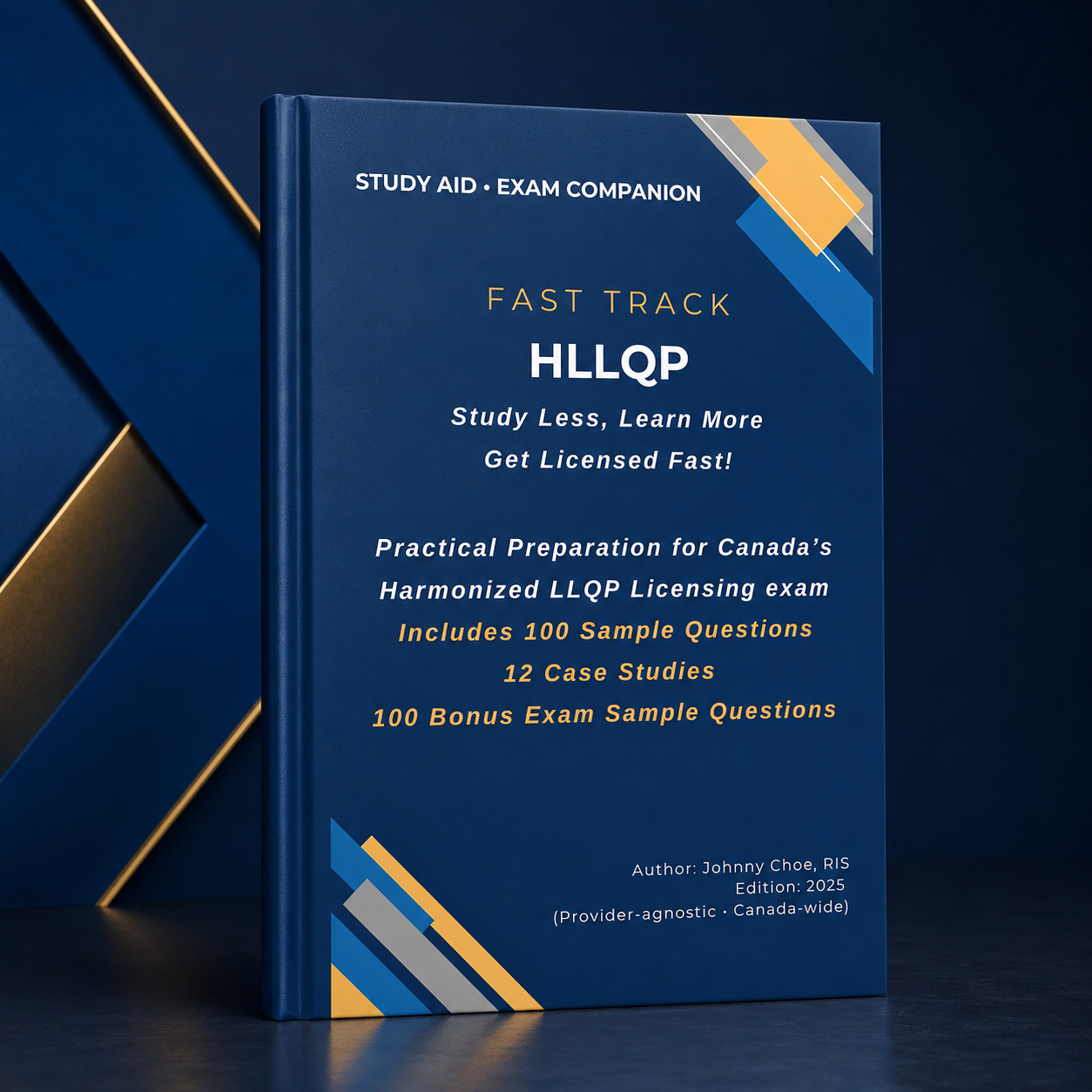
I wrote Fast-Track HLLQP: Study Less, Learn More! not to offer a shortcut that replaces serious preparation.
I wrote it to help candidates understand what matters, how concepts connect, and how to apply what they learn.
“Study Less, Learn More” Does Not Mean Looking for a Shortcut
The subtitle of the book is Study Less, Learn More!
That does not mean candidates can prepare with minimal effort. The HLLQP covers life and health insurance, insurance-related investment products, ethics, and professional practice. Memorizing a few practice questions without understanding the underlying material is not a reliable study strategy.
“Study Less” means reducing the time spent repeatedly reading the same pages or memorizing every sentence without context.
“Learn More” means understanding the structure of a concept, comparing similar products, and recognizing which principle applies to a particular situation.
For example, it is not enough to memorize the definitions of Term Life and Permanent Life. Candidates should also be able to consider:
- What need is each type of coverage intended to address?
- How do premiums and coverage periods differ?
- Which elements are guaranteed and which are non-guaranteed?
- What should be considered in relation to the client’s budget, timeframe, and objective?
- Which limitations and trade-offs should be explained before making a recommendation?
Knowing the definition is the starting point.
The knowledge becomes useful—both on the exam and in a client conversation—when you can compare and apply it.
The Book Is Grounded in Real Financial Services Experience
I have worked in Ontario as an Investment Funds Advisor and Mutual Funds Representative, and I hold the Responsible Investment Specialist (RIS) designation. My work with clients across insurance and investments has allowed me to apply needs-based planning and client-first advice in real situations.
Previously, I served as a Business Development & Sales Manager with Desjardins Financial Security Independent Network, part of a major Canadian financial institution. I also worked as an Investment Fund Advisor with Desjardins Financial Security Investments Inc.
As a Sales Manager, I recruited and trained new insurance advisors. I saw where candidates struggled while completing the licensing process—and what they still needed to learn after passing the exam and entering the profession.
As an LLQP and Mutual Fund Licensing instructor and coach, I have also spent years turning difficult material into checklists, memory cues, and exam-style drills.
Fast-Track HLLQP is therefore more than a condensed version of another textbook.
It is a study aid shaped by the questions students and new advisors repeatedly asked, the concepts they frequently confused, and the professional judgment they needed after the exam.
The HLLQP Exam Tests More Than Product Knowledge
When candidates study for the HLLQP, it is natural to focus on product features and contract provisions.
Choosing the best answer, however, also requires the ability to understand the client’s circumstances.
Some questions present two or more choices that appear reasonable. Selecting the option with the most familiar terminology can lead to a mistake.
Candidates may also need to consider:
- Does the recommendation match the client’s needs and objectives?
- Is it consistent with KYC and KYP principles?
- Have the costs, risks, and limitations been explained along with the benefits?
- Have conflicts and other material information been disclosed?
- Has the process and the reason for the recommendation been properly documented?
- Which answer best supports client protection and professional conduct?
That is why the book includes an Exam Lens alongside key concepts.
The purpose is to help candidates look beyond the vocabulary in a question and identify the principle or judgment the question is testing.
The Four Core Modules Are Connected into One Learning Framework
Fast-Track HLLQP is organized to help candidates connect the major HLLQP subject areas instead of treating each one as an isolated collection of facts.
Life Insurance
The book begins with risk and insurance contract fundamentals before covering Term Life, Whole Life, Participating Whole Life, Universal Life, riders, underwriting, policy delivery, claims, needs analysis, replacement, and basic tax concepts.
Accident & Sickness Insurance
This section reviews Disability Income Insurance, Critical Illness Insurance, health products, individual and group benefits, and frequently tested contract provisions.
Segregated Funds and Annuities
Candidates examine segregated fund guarantees, resets, fees, and suitability, as well as the basic structure of annuities and considerations for registered and non-registered implementations.
Ethics and Professional Practice
This part connects the client-first standard with KYC, KYP, suitability, conflicts, advertising and sales practices, privacy, recordkeeping, AML/ATF, and complaint handling.
The final sections use exam strategies, Quick Sheets, practice questions, and case studies to help candidates apply what they have learned.
Why the Reason Behind a Wrong Answer Matters More Than the Score
The book includes 100 Sample Questions, 100 Bonus Exam Sample Questions, and 12 Case Studies.
Completing many practice questions can certainly help.
But checking the score and immediately moving to the next set may cause a candidate to repeat the same mistake.
After each practice question, ask:
- Why is the correct answer right?
- Why are the other choices less appropriate?
- Which word or fact in the question changes the decision?
- Would the answer change if one condition in the scenario were different?
If you answer a question correctly but cannot explain why, the underlying concept may not yet be secure.
If you answer incorrectly but identify the flaw in your reasoning, meaningful learning has taken place.
Case studies add another level of practice by connecting several concepts within one situation. Looking at a client’s age, family circumstances, income, existing coverage, objectives, and risks helps candidates see how definitions become part of a recommendation process.
Provider-Agnostic, but Not a Replacement for the Official Textbook
Fast-Track HLLQP is a provider-agnostic study aid. It is not written around the procedures or course materials of one education provider or insurance company.
The book focuses on common Canada-wide concepts and general market-conduct principles while reminding candidates that terminology and processes may differ among provinces and territories.
It does not replace the official textbook supplied by an approved HLLQP course provider.
The most effective way to use the book is to:
- Study the complete curriculum through your official HLLQP course material.
- Use Fast-Track HLLQP to organize key concepts and comparison points.
- Reinforce your memory with checklists and mnemonics.
- Test your application skills through practice questions and case studies.
- Return to the official text and current provider guidance when reviewing a weak area.
Licensing rules, examination procedures, and regulatory requirements can change. Candidates should always verify current information with their course provider, provincial or territorial regulator, and sponsoring firm.
Choose a Study Plan That Fits Your Circumstances
Candidates do not all need to study at the same pace.
Some people prepare while working full-time. Others can focus intensely for a defined period. A candidate with no insurance background also starts from a different place than someone who already has financial-services experience.
The book offers three example schedules that candidates can adapt:
- 4-Week Sprint: For candidates who can concentrate over a shorter period
- 6-Week Standard: For those who want a balanced schedule of learning and review
- 8-Week Part-Time: For candidates combining study with work or other responsibilities
Whichever plan you choose, do not measure progress only by the number of hours spent at a desk.
Give each study session a specific objective.
Decide whether today’s goal is to compare policy types, map the underwriting process, or analyze errors in an ethics question.
Completing one focused objective may be more productive than spending several unfocused hours reading.
Who Is Fast-Track HLLQP For?
The book was created for:
- Candidates who do not know where to begin their HLLQP preparation
- Students who have read their official material but struggle to organize the key concepts
- Candidates who repeatedly confuse similar products or insurance terminology
- Learners who want to understand the reasoning behind an answer, not just memorize it
- Candidates preparing for another attempt who want to repair weak areas systematically
- Readers who want to identify the important points within lengthy textbook explanations
- Future advisors who want to prepare for the profession as well as the licensing exam
This is not an unauthorized collection of actual exam questions or a question bank that guarantees a passing result.
It is designed to help candidates organize concepts and practise exam-style thinking rather than memorize answers.
The Licensing Exam Is the Beginning, Not the Destination
One message in the book is especially important to me:
Licensing tests what you know. The profession reveals what kind of advisor you are.
Knowledge is necessary to pass the exam.
Once you begin meeting clients, however, knowledge alone is not enough. Advisors must listen, ask appropriate questions, explain clearly, and exercise the professional judgment not to make an unsuitable recommendation.
Preparing for the HLLQP is both an examination process and the first step in learning the language and responsibilities of a new profession.
That is why Fast-Track HLLQP includes not only exam strategy, but also the client-first standard, suitability, documentation, and professional habits.
Studying to pass the exam and preparing to become a good advisor do not have to be separate goals.
Discover Fast-Track HLLQP
Fast-Track HLLQP: Study Less, Learn More! is a practical study aid that uses checklists, mnemonics, case drills, and exam-style questions to help candidates organize the core concepts of Canada’s HLLQP.
You can learn more about the book and find the available formats in Johnny Choe’s Bookstore.
Visit Johnny Choe’s Bookstore →
Would You Like Help Preparing for the HLLQP?
If you have questions about HLLQP exam preparation, the licensing process, study planning, or related classes, please feel free to contact me.
Important Notice
This article and Fast-Track HLLQP are supplementary resources intended for general education and exam preparation. They do not replace the official textbook, course, assessment, or guidance provided by an approved HLLQP course provider or a provincial or territorial regulator.
The book is independent and is not affiliated with or endorsed by any regulator, council, insurer, or course vendor. Licensing rules, examination procedures, product information, and regulatory requirements can change, so candidates must consult the most current official sources.
The questions and case studies in the book are original educational examples. They are not actual examination questions and do not guarantee an examination result, licence approval, employment, or business outcome.