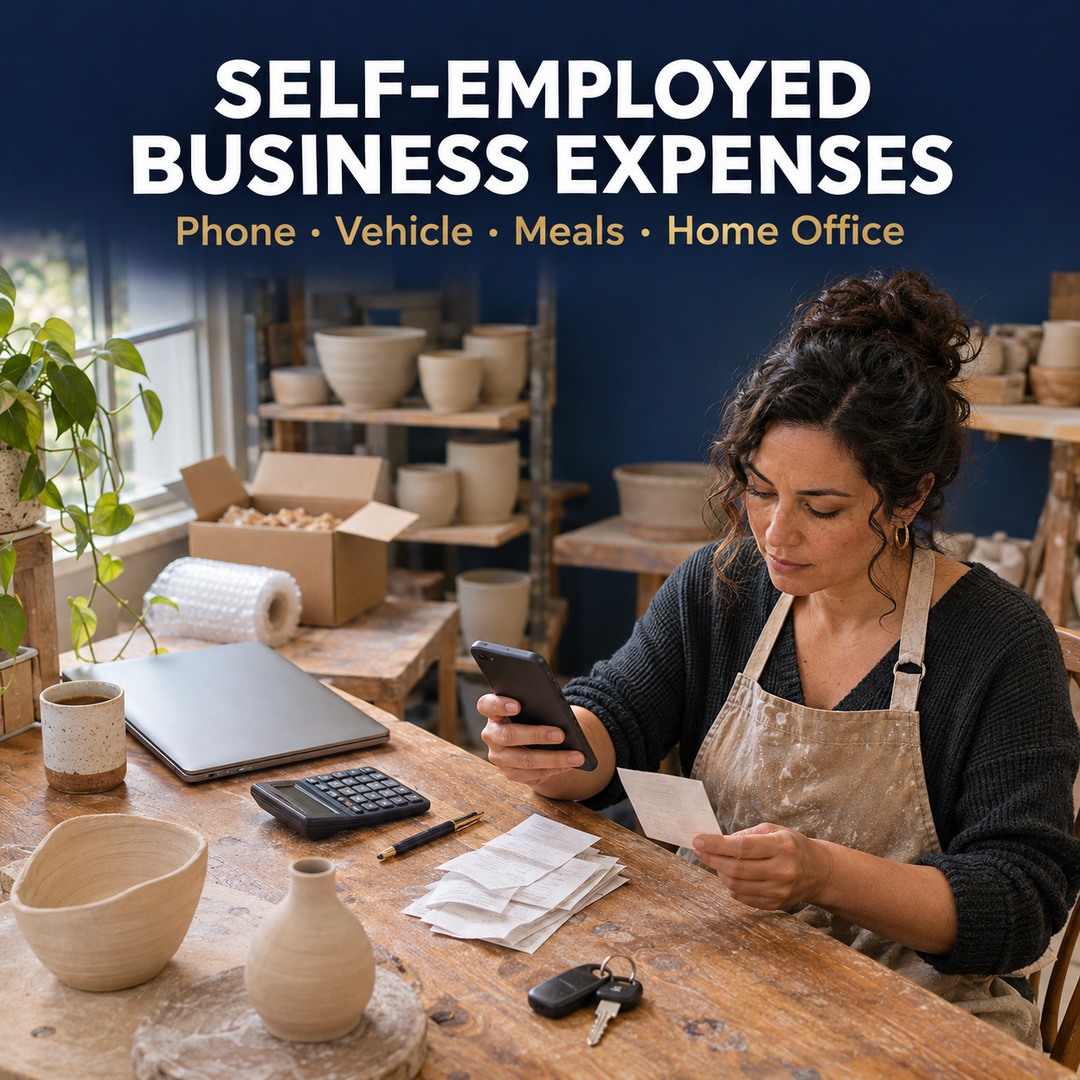


Running a business costs money. You may pay for a cellphone, software, advertising, supplies and travel. You might drive to meet clients or use part of your home as an office.

Does that mean every business-related purchase is deductible?
Not necessarily. In Canada, self-employed business expenses must have a reasonable connection to earning business income. Personal costs are not deductible. Mixed-use expenses must be divided between business and personal use. Long-term equipment may also be treated differently from everyday operating costs.
This guide explains the main expense categories reported on Form T2125. It covers phone and internet costs, meals, vehicle expenses, home-office costs and equipment. You will also see a practical example and a year-end checklist.
Ask four questions before claiming an expense
Before sorting expenses into categories, ask these four questions:
- Did I incur this cost to earn business income?
- If there was personal use, what portion relates to the business?
- Is this a current expense or an asset that will last for several years?
- Can I support the amount with a receipt and payment record?
The CRA generally allows reasonable current expenses incurred to earn business income. However, you cannot deduct personal expenses. If a purchase has both uses, only the business portion belongs on Form T2125.
Suppose you use your cellphone 60% for work. Claiming the entire bill would be difficult to support. You need a reasonable method for calculating the business portion. The same principle applies to vehicles and home offices.
A business deduction is not a dollar-for-dollar refund
A deductible expense reduces net business income. The lower amount may affect your income tax and CPP contributions.
However, the government does not refund the full cost of the purchase. Spending $1,000 does not automatically reduce your tax by $1,000. Instead, the deductible amount reduces the income on which tax is calculated.
Be careful with the idea that a purchase is worthwhile because it is “a write-off.” You still spent the money. The expense should make sense for the business before considering its tax treatment.
Advertising and online marketing
Advertising used to promote your business is a common operating expense. Possible examples include:
- Search-engine and social-media advertising
- Flyers and business cards
- Website hosting and domain fees
- Business photography and video production
- Email marketing services
- Promotional fees charged by an online marketplace
Personal and business activities sometimes overlap. Using a personal social-media account for business does not turn every photography or communication expense into a deduction.
Keep records showing what the campaign promoted. Save the platform invoice, payment confirmation and advertising report where possible.
Office supplies and small consumable items
Paper, pens, printer ink, postage and packaging materials are usually consumed within a short period. They may qualify as current expenses when used for the business.
For an online store, shipping boxes, labels and protective packaging may also have a direct business purpose.
Desks, chairs and printers are different. These items usually provide a benefit over several years. Before entering the full cost as office supplies, consider whether the purchase is a capital asset.
Consumable supplies are generally deducted in the year they are used. Long-term assets may be deducted over time through capital cost allowance (CCA).
Can you deduct a computer, cellphone or furniture immediately?
A laptop, smartphone, camera or office desk may be essential to your work. That does not always mean you can deduct the full purchase price as an ordinary expense.
Equipment used for several years is generally treated as capital property. You may need to identify the correct CCA class and apply the business-use percentage. The calculation can depend on the asset type and acquisition date.
Imagine that you buy a $2,000 laptop. You use it 80% for business and 20% personally. First, identify the business portion. Then determine whether the purchase should be included in a CCA class instead of being deducted as a current expense.
Monthly cloud storage and accounting software have a different character. A recurring service used for the business may qualify as a current expense.

Cellphone and internet expenses
Many self-employed people use one cellphone for both work and personal life. In that case, claim only the portion used to earn business income.
Business use is not limited to voice calls. You may also consider email, client messages, video meetings and business applications. Still, avoid assuming that the bill is 100% deductible simply because you are self-employed.
For example, suppose your monthly cellphone bill is $100. If a reasonable business-use percentage is 60%, you may use $60 as the monthly business portion. The cost of buying the phone may require separate capital-property treatment.
The same idea applies to home internet. If the entire family uses the connection, divide the cost reasonably. Utilities connected to a home workspace may belong in the business-use-of-home calculation. Do not claim the same amount twice.
Software and subscription fees
Accounting software, design applications, video-conferencing platforms and cloud storage are common business tools. Monthly or annual subscriptions may qualify as current expenses when they directly support the business.
A personal streaming service does not become fully deductible because it is occasionally used for work. Separate the business purpose from personal use.
Prepaid expenses also need attention. If you pay several years of service fees in advance, you may need to allocate the cost to the periods covered.
Bank charges and payment-processing fees
Monthly fees on a business bank account can be connected to business operations. Merchant and payment-processing fees are also easy to overlook. These charges may be deducted from your sales before the payment reaches your bank account.
Interest on a business credit card or loan depends on how the borrowed money was used. Interest on funds used for the business may be deductible. The principal portion of a loan payment is not an ordinary business expense.
Separating business and personal accounts makes this easier. A separate account is not what creates the deduction. However, it gives you a clearer record of each transaction.
Accounting, legal and professional fees
Accounting fees for bookkeeping, income tax returns and GST/HST returns may qualify as business expenses. Legal advice and consulting services required for the business may also be deductible.
Personal work is different. A personal will or family-law matter does not become a business expense. If one invoice covers both business and personal services, ask the professional to separate the charges.
Business insurance premiums
Commercial property insurance, professional liability coverage and general business liability insurance may qualify as business expenses.
Personal life insurance and personal homeowners insurance are not automatically deductible. A portion of home insurance may be considered within an eligible home-office calculation.
Review what the policy covers. If one premium includes several types of protection, identify the portion that relates to the business.
Meals and entertainment are generally limited to 50%
Meals with clients and business entertainment often create confusion. Under the CRA’s general rule, the deductible amount is limited to 50% of the lesser of:
- The actual amount incurred
- An amount that is reasonable in the circumstances
Suppose you pay $120 for a client meeting. The general deductible amount may be $60. However, a receipt alone may not show why the meal was business-related.
Add these details to your records:
- Who attended
- The business purpose of the meeting
- The date and location
- The amount paid, including the tip
An ordinary lunch eaten alone is often personal. Working while eating does not automatically make the meal deductible. Separate rules or exceptions may apply to certain travel, conventions and industries.
Business travel and accommodation
You may be able to deduct airfare, train fares, accommodation and local transportation for a business trip. The main purpose of the trip should be business-related.
If you add a personal vacation, exclude the personal portion. Costs for an accompanying spouse or family member do not automatically become business expenses.
Keep the itinerary, event registration, meeting emails and receipts together. These records help show why the travel occurred. The general 50% limit may still apply to meals during business travel.
Vehicle expenses depend on business kilometres
If you use one vehicle for both business and personal driving, you cannot simply deduct all fuel and operating costs. A common calculation is:
Business kilometres ÷ total annual kilometres
Assume you drive 20,000 kilometres during the year. Of that distance, 6,000 kilometres relates to earning business income. Your business-use percentage is 30%.
That percentage may apply to eligible fuel, insurance, maintenance and registration costs. Business parking and supplementary business insurance may receive different treatment. A vehicle purchase is not an operating expense, so review the CCA rules separately.
A mileage log is essential. Record the following for each business trip:
- Date
- Starting point and destination
- Business purpose
- Kilometres driven
- Odometer reading at the beginning and end of the fiscal period
Do not assume that every trip between home and a regular workplace is business travel. The answer can depend on where the business operates and why the trip occurred.
Who can claim business-use-of-home expenses?
Working from home occasionally does not automatically make part of every household bill deductible. The CRA applies eligibility conditions to business-use-of-home expenses.
Generally, the workspace must meet one of these conditions:
- It is your principal place of business
- You use it only to earn business income and regularly meet clients, customers or patients there
If eligible, you may calculate a business portion of heat, electricity, cleaning supplies, home insurance and rent. A homeowner may also review the business portion of property taxes and mortgage interest.
A reasonable calculation often uses the workspace area divided by the home’s total area. If the space also serves a personal purpose, you should consider the hours of business use.
For example, a dedicated 100-square-foot office in a 1,000-square-foot home represents 10% by area. If it also serves as a guest room, the actual use may require another adjustment.
Business-use-of-home expenses cannot create or increase a business loss. An unused amount may be carried forward if you continue to meet the conditions.
Avoid double-counting. The same internet or electricity cost should not appear once as a regular expense and again in the home-office calculation.
Repairs are different from improvements
Minor repairs that restore business property or equipment to its original condition may be current expenses. Work that substantially improves an asset or extends its useful life may be capital in nature.
The description on the invoice is not the only factor. Consider what the work actually accomplished.
Reduce the claim if an insurer reimbursed the repair. You also cannot assign a dollar value to your own labour and deduct it as a repair expense.
Paying a spouse or child for work
You may pay a spouse or child who performs real work for the business. The compensation must be reasonable for the duties performed.
Keep the job description, hours and pay rate. You should be able to compare the amount with what you would pay someone else for similar work.
Payroll deductions, T4 reporting and employer obligations may apply. A transfer for household spending is not the same as a documented wage payment.
Inventory is not the same as office supplies
A business that sells products must account for inventory. The cost of products held for resale does not automatically become an office expense.
Cost of goods sold generally considers opening inventory, purchases and closing inventory. Unsold products remaining at year-end may not be fully deductible that year.
Online sellers, food businesses and product makers should maintain separate inventory records. Shipping boxes and packing materials may have a different treatment from the products being sold.
GST/HST registrants should check the tax portion
A GST/HST registrant may claim eligible tax paid on business inputs as an input tax credit (ITC). If you claim an ITC, do not deduct the same tax again as part of the T2125 expense.
Suppose an expense is $100 plus $13 HST. If you claim the $13 as an ITC, the income tax expense generally uses the net amount rather than $113.
Treatment may differ for a business that is not registered for GST/HST. Keep records consistent with your registration status and accounting method.
Common self-employed business expense mistakes
These problems appear frequently:
- Claiming personal meals and clothing as business expenses
- Deducting 100% of a shared phone or internet bill without support
- Claiming all vehicle costs without a mileage log
- Treating a laptop or furniture as ordinary office supplies
- Claiming the same home-office cost in two places
- Deducting GST/HST already claimed as an ITC
- Entering an entire credit-card payment or loan payment as an expense
- Keeping a bank statement but no receipt or invoice
- Mixing inventory purchases with operating expenses
- Treating an owner’s withdrawal as a wage or business expense
Paying with a personal account does not automatically disqualify a genuine business expense. The reverse is also true. Paying a personal purchase with a business card does not make it deductible.
The purpose and nature of the transaction matter more than the payment method.
What information should a receipt show?
The CRA requires records that support business income and expenses. An expense receipt should generally show:
- Purchase date
- Seller or supplier name and address
- Buyer name and address
- Clear description of the goods or services
- Amount paid
- Supplier’s GST/HST registration number when required
A bank or credit-card statement may show only the merchant and total. Keep the invoice or receipt that identifies what you purchased.
If a supplier does not provide a receipt, record the date, supplier information, amount and transaction details in your expense journal. Document cash expenses promptly.
Business records generally need to be kept for at least six years from the end of the relevant tax year. Electronic records should remain clear and accessible.
Example: Organizing an online consultant’s expenses
Mina operates an online consulting business from home. During the year, she pays the following amounts:
| Expense | Total paid | What to review |
|---|---|---|
| Cellphone service | $1,200 | 60% business use |
| Accounting software | $480 | Business-only subscription |
| Client meals | $300 | Business purpose and general 50% limit |
| Vehicle operating costs | $6,000 | 25% of total kilometres were for business |
| Laptop | $2,000 | Business-use portion and CCA treatment |
| Home internet | $960 | Personal use and home-office treatment |
Mina does not claim the entire cellphone bill. She reviews a $720 business portion based on 60% use. She documents the client meetings and applies the general 50% meals limit.
The $6,000 of vehicle costs is not fully deductible either. Her mileage log supports a 25% business-use calculation. The laptop provides a long-term benefit, so she reviews whether CCA applies.
Each receipt requires a different decision. The first step is to identify the nature and business purpose of the cost.
Self-employed business expenses checklist
- Does every expense relate to earning business income?
- Have you removed the personal-use portion?
- Did you record total and business vehicle kilometres?
- Did you note who attended business meals and why?
- Does the home workspace meet the eligibility requirements?
- Have you reviewed equipment and furniture as possible capital assets?
- Did you avoid deducting GST/HST already claimed as an ITC?
- Can you connect each receipt, invoice and payment record?
- Have you separated inventory from ordinary operating expenses?
- Did you check for duplicate entries?
Claim expenses you can explain and support
The goal is not to collect as many receipts as possible. It is to identify reasonable business expenses and preserve the calculation behind each claim.
Shared cellphone, vehicle and home-office costs need supportable percentages. Computers and furniture may require CCA treatment. Meals need a business purpose and are generally subject to the 50% limit.
Sort expenses at least once a month. Consider using a separate business account and credit card. Add a short note to each receipt while the purpose is still fresh. Those habits make Form T2125 much easier to complete.
CRA resources
- Business expenses
- Expenses section of Form T2125
- Motor vehicle expenses and records
- Business-use-of-home expenses
- Business records and receipts
Related reading
- Self-Employed Tax Return in Canada: How to Complete Form T2125
- Do You Need to File Taxes With No Income in Canada?
- T1 General Tax Return Guide: How Canadian Personal Income Tax Filing Works
Visit Johnny’s Bookstore
Would you like to build a clearer understanding of Canadian investing, registered accounts and personal finance?
Need help?
Are you unsure which costs belong on your self-employed tax return? We can review your records and help organize expense categories and business-use percentages before you complete Form T2125.
Important notice
This article provides general educational information as of November 11, 2026. Tax rules, GST/HST requirements, filing forms and deduction criteria may change. Confirm current information with the CRA for the relevant tax year.
This article is not personalized tax, accounting, legal or financial advice. Business structure, industry, province, expense type, asset classification and GST/HST registration can change the filing result.
Legal Notice & Financial Disclaimer
